
drawdb-mcp
Database ER-diagram editor with a built-in MCP server — let Claude and other AI assistants design, edit, and export database schemas (SQL/DBML) in natural language. Self-hostable, Docker-ready.
Documentation
This fork of DrawDB extends the original with AI assistant integration via Model Context Protocol (MCP). AI assistants like Claude can create, modify, and manage database diagrams programmatically.
The backend owns the diagram. MCP tools read and write the authoritative state directly, so every tool works whether or not a browser is open — you do not need the editor running for an assistant to build a schema. When a GUI _is_ connected it acts as a synced view: the backend pushes each committed change to it, and edits made in the editor are submitted back. A tab that reconnects adopts whatever the backend holds.
Relationship to Upstream DrawDB
This project began as a fork of DrawDB but has since diverged substantially and is intentionally not kept in sync with upstream. Selected fixes and features are occasionally cherry-picked from the parent project, but the two will continue to drift apart as drawdb-mcp evolves on its own. DrawDB remains a separate, actively maintained project, and full credit goes to its authors — see drawdb-io/drawdb.
Demo Video
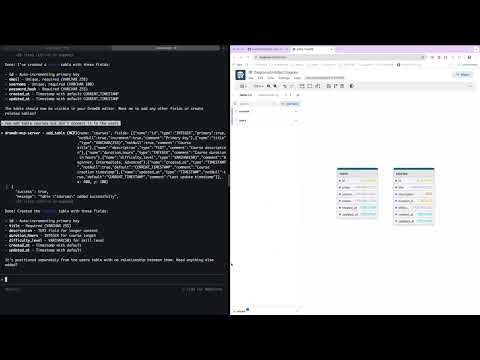
Watch how to design database schemas using natural language with Claude AI.
Architecture:
- apps/gui: React frontend derived from DrawDB — a synced view of the backend's diagram, not the store
- apps/backend: NestJS MCP server that holds the authoritative diagram state
- packages/diagram-core: framework-free domain layer — entity schemas, the state reducer, the datatype tables and the SQL/DBML codecs, so the backend can render exports with no GUI running
- packages/remote-control-contract: the typed ORPC contract both directions of the socket share
- Built with Turborepo and pnpm workspaces
Getting Started
Quick Start with Docker (Recommended)
The easiest way to get started is using Docker:
docker run \
  --name drawdb-mcp \
  -p 8080:80 \
  -p 3000:3000 \
  --restart unless-stopped \
  ghcr.io/anatoly-lab/drawdb-mcp:latest
Then:
1. Open GUI: http://localhost:8080
2. Connect Claude Code to the MCP server:
claude mcp add --transport http drawdb-mcp http://127.0.0.1:3000Now Claude can create and modify database diagrams for you!
Prereleases
`latest` tracks stable releases only. Betas and release candidates are published under their exact version and never move `latest`, so pin the full version to run one:
docker run \
  --name drawdb-mcp \
  -p 8080:80 \
  -p 3000:3000 \
  ghcr.io/anatoly-lab/drawdb-mcp:2.0.0-beta.1
See GHCR_DEPLOYMENT.md for available tags and advanced usage.
Local Development
Prerequisites
- Node.js 20.19+ or 22.22+ (see `engines` in `package.json`)
- pnpm 8.15.0+ (install via `npm install -g pnpm`)
Start both GUI and backend:
git clone https://github.com/anatoly-lab/drawdb-mcp
cd drawdb-mcp
pnpm install
pnpm dev
Start GUI only:
pnpm gui:dev
# Access at http://localhost:5173
Start backend only:
pnpm backend:dev
# WebSocket at ws://localhost:3000/remote-control
Build
Build both applications:
pnpm install
pnpm build
Build specific app:
pnpm build --filter=gui
pnpm build --filter=backend
Connect Claude Code to MCP Server
When running locally, connect Claude Code:
claude mcp add --transport http drawdb-mcp http://127.0.0.1:3000The frontend connects to the backend over WebSocket automatically. Remember it is a view of the backend's state rather than the store: the tools keep working with no browser open, and a tab that reconnects adopts whatever the backend holds.
Docker Deployment
See DOCKER_BUILD.md for detailed build instructions.
Build with Docker Compose:
docker-compose up --build
# Access at http://localhost:8080
Or build directly:
docker build -t drawdb-mcp:local .
docker run -p 8080:80 -p 3000:3000 drawdb-mcp:local
The Docker image includes both frontend and backend. WebSocket is proxied through Nginx.
Updating to New Versions
When updating to a new version (whether via Docker or local development), you must perform a hard refresh in your browser to clear the cached frontend JavaScript:
- Windows/Linux: `Ctrl + Shift + R` or `Ctrl + F5`
- macOS: `Cmd + Shift + R`
Without a hard refresh, the browser may continue using the old cached frontend code even though the backend has been updated, which can cause errors or unexpected behavior.
Features
Export & Import
The MCP server provides tools for exporting and importing database diagrams in multiple formats:
Export Formats:
- SQL DDL: Export database-specific SQL statements (PostgreSQL, MySQL, SQLite, MariaDB, MSSQL, Oracle)
- DBML: Export to Database Markup Language (human-readable, database-agnostic format)
- JSON: Export complete diagram state for backup/restore
Import Formats:
- DBML: Import database schemas from DBML format
- JSON: Import complete diagram state
Available MCP Tools:
- `export_sql` - Export diagram as SQL DDL for current database type
- `export_dbml` - Export diagram as DBML
- `import_dbml` - Import database schema from DBML
- `export_diagram` - Export complete diagram as JSON
- `import_diagram` - Import complete diagram from JSON
See CLAUDE.md for complete list of available MCP tools and their usage.
License & Credits
This project is licensed under the GNU Affero General Public License v3.0 (AGPL-3.0), inherited and retained from upstream DrawDB. See the LICENSE file for the full text.
Built on top of DrawDB by the DrawDB authors and contributors. Huge thanks to the original project for the foundation this fork is built on.
Frequently asked questions
What is drawdb-mcp?
drawdb-mcp is Database ER-diagram editor with a built-in MCP server — let Claude and other AI assistants design, edit, and export database schemas (SQL/DBML) in natural language. Self-hostable, Docker-ready.
How do I install drawdb-mcp?
Open the GitHub repository and follow its README. Most MCP servers are added to your client's MCP config, then called by your agent.
Is drawdb-mcp open source?
Yes — it is hosted on GitHub at https://github.com/anatoly-lab/drawdb-mcp and has 25 stars.
Related MCP tools
 atlassian-mcp-server
Official remote MCP server for Atlassian. Securely connect Jira, Confluence, Jira Service Management, Bitbucket, and Compass to Claude, ChatGPT, Cursor, VS Code, and other AI tools using OAuth 2.1 or API tokens.
 unity-mcp
Unity MCP acts as a bridge between AI assistants and your Unity Editor. Give your LLM tools to manage assets, control scenes, edit scripts, and automate tasks within Unity.
 Unity-MCP
AI Skills, MCP Tools, and CLI for Unity Engine. Full AI develop and test loop. Use cli for quick setup. Efficient token usage, advanced tools. Any C# method may be turned into a tool by a single line. Works with Claude Code, Gemini, Copilot, Cursor and any other absolutely for free.
 OpenOSINT
AI-powered OSINT agent with interactive REPL, MCP server, and CLI. 19 tools. Works with Claude, GPT-4, or local models. For authorized security research only.
 tuui
tuuiA desktop MCP client designed as a tool unitary utility integration, accelerating AI adoption through the Model Context Protocol (MCP) and enabling cross-vendor LLM API orchestration.
 projectmem
Open-source coding agent memory. Records issues, attempts, fixes and decisions, then warns your agent before it repeats an approach that already failed. Native MCP server for Claude Code, Cursor, Antigravity and Codex. 100% local, no cloud, no telemetry. MIT.
Run your own MCP server? See who uses it and what to fix.
Measure it with TrackMCP