
pronounce
🔊 Hear how developers actually pronounce kubectl, nginx, GIF & 1,900+ tech terms. Sourced dictionary + CLI + VS Code + GitHub Action + MCP + Agent Skill.
Documentation
🔊 say-it · Pronounce
Stop saying "kub-cuttle". One Bash command pronounces 1,903 developer jargon names — most with a cited source.
🌐 ·
🇨🇳 ·
📖 ·
🎯 ·
🎤 ·
🔌
· ⚙️
·
·
🚀 Try it in 30 seconds
git clone https://github.com/anzy-renlab-ai/pronounce.git
cd pronounce && ./install.sh
say-it kubectl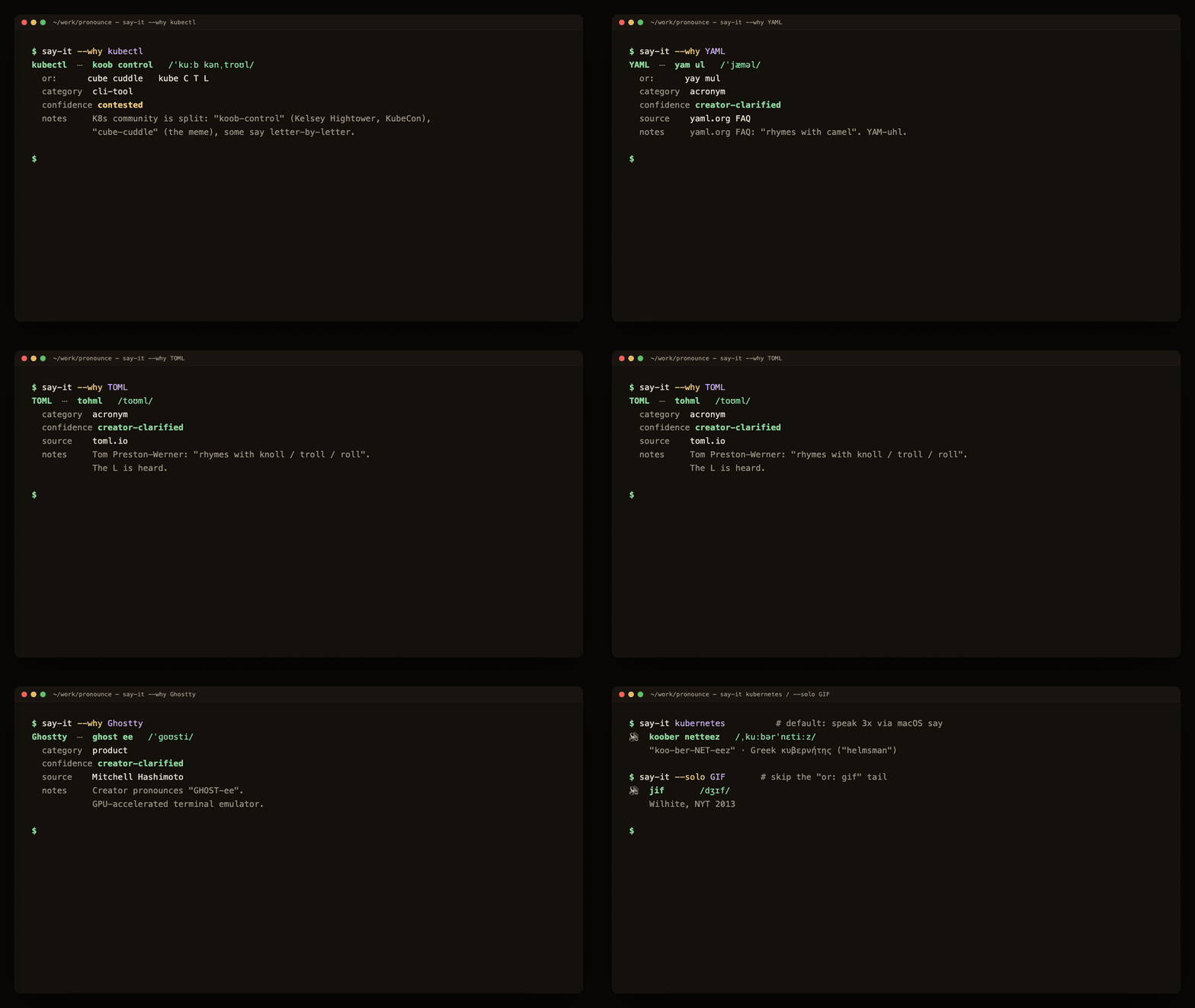
That's it. Now try `say-it GIF`, `say-it nginx`, `say-it Pydantic`, `say-it --why JSON`, or `say-it quiz` for a 10-question challenge. Linux users: install `espeak-ng` (`sudo apt install espeak-ng`) and the CLI just works. Windows: same CLI under WSL or git-bash + PowerShell. Or skip install and use the browser at **pronounce.renlab.ai**.
> ⭐ If `say-it kubectl` saves you one cringey standup moment — **star the repo**. It nudges more devs to contribute their favorite mispronounced project name.
🏆 The developer pronunciation scoreboard
1,903 entries — 1,283 carry a citable source — 108 settled by the creator themselves, 175 the community still argues about. The famous ones:
✅ Settled — the creator said so
| Word | It's… | …not | Settled by |
|---|---|---|---|
| **GIF** | "jif" | "ghif" (hard-G speech cue) | Steve Wilhite (creator), NYT 2013 |
| **nginx** | "engine X" | "n-jinx" | NGINX official |
| **YAML** | "yam-ul" | "yammel" | yaml.org |
| **GNU** | "guh-NEW" (hard g) | "noo" | GNU Project |
| **LaTeX** | "lay-tek" | "lay-teks" | Lamport / LaTeX project |
| **TOML** | rhymes with "knoll" | "tom-el" | Tom Preston-Werner (creator) |
| **Tcl** | "tickle" | "T-C-L" | John Ousterhout (creator) |
| **awk** | "auk" (like the bird) | "A-W-K" | Aho / Weinberger / Kernighan |
⚔️ Still contested — both readings are in active use
| Word | Camp A | Camp B |
|---|---|---|
| **kubectl** | "koob-control" | "cube-cuddle" |
| **SQL** | "sequel" | "S-Q-L" |
| **JSON** | "JAY-son" | "JEE-son" |
| **GUI** | "gooey" | "G-U-I" |
| **JWT** | "jot" (per RFC 7519) | "J-W-T" |
Every cell has IPA and audio; 1,283 also carry a citable source. **Browse all 1,903 entries →**
> Disagree with one? That's the whole point — open a PR with your reading and a source. The argument *is* the dataset.
What you're actually getting
- 1,903 entries — 1,283 carry a citable source. Confidence-tagged (`creator-clarified` / `community-consensus` / `contested`), each with a citable URL where one exists (we'd rather leave it blank than fabricate one). Wilhite said GIF is "jif" at the 2013 Webby Awards. Crockford says JSON is "JAY-son" (RailsConf 2009). RFC 7519 says JWT is "jot". The dictionary cites them.
- Multi-reading audio. For words where the debate is real — GIF, SQL, GUI, char, regex — the CLI chains the alternates after the primary with a spoken "or:" so you *hear* the debate without staring at the terminal. `--solo` skips the tail once you've internalized it.
- One Bash CLI, no npm runtime. No sudo, no framework bootstrap, no surprises. It detects macOS `say`, Linux `espeak-ng`/`espeak`, or Windows PowerShell `System.Speech`. The repo also ships a Claude Code skill and an MCP server so your AI answers "how do you pronounce X?" with audio, not a phonetic guess.
- A docs-native GitHub Action. Scan Markdown changed by a pull request and emit a sourced pronunciation glossary in the job summary — no API key, dependency install, or network request.
- Canonical website audio. The site plays each committed canonical MP3 first and uses Web Speech only as a fallback if playback fails.
$ say-it --why JSON
word              JSON
ipa               /ˈdʒeɪsən/
respelling_us     jay son
confidence        contested
source            Wikipedia § Pronunciation
url               https://en.wikipedia.org/wiki/JSON#Pronunciation
Why not just Google?
Because Google gives you 47 Reddit arguments and a YouTube clip you have to unmute. IPA gives you `/ˈkuːb kənˌtroʊl/` — a reference, not a teacher.
You don't need a phonetic transcription. You need to hear the word. Twice. Maybe three times. Done.
`say-it` ships a community-maintained dictionary of how engineers actually say the names that trip everyone up — and feeds the *intended* respelling to your OS's text-to-speech engine, so `kubectl` comes out as `koob-control`, not whatever your computer guessed from the letters.
Famous moments
Some pronunciations aren't opinions — the creators settled them. The dictionary cites every one:
| Word | Reading | Source |
|---|---|---|
| `GIF` | "jif" (creator says so) | Steve Wilhite, Webby Awards 2013 |
| `JSON` | "jay-son" | Douglas Crockford, RailsConf 2009 |
| `GNU` | "g-noo" (hard G, one syllable) | GNU Project official |
| `Linux` | "LIN-ux" (short i, schwa) | Linus Torvalds himself |
| `LaTeX` | "lay-tek" (or "lah-tek") | Leslie Lamport, official |
| `Django` | "JANG-go" (silent D) | Django FAQ |
| `Vue` | "view" (one syllable) | Evan You, Vue docs |
| `Vite` | "veet" (French for *quick*) | Vite docs |
| `Knative` | "KAY-native" (the K is voiced) | Knative docs |
| `etcd` | "et-cee-dee" (et-cetera-distributed) | etcd FAQ |
Run `say-it --why ` to see the citation when an entry has a `source_url`; unsourced entries are left blank rather than given a fabricated URL.
Install
brew install anzy-renlab-ai/tap/say-it # Homebrew on macOSOr the "Try it in 30 seconds" block above. `./install.sh` drops:
- the CLI at `~/.local/bin/say-it`,
- the pronunciation dictionary at `~/.local/share/say-it/pronunciations.tsv`,
- if you use Claude Code, a `pronounce-word` skill at `~/.claude/skills/pronounce-word/` so any "how do you say X?" prompt to your AI gets answered with audio instead of IPA,
- the same skill into `~/.agents/skills/` (Codex CLI) and `~/.kiro/skills/` (Kiro) when those dirs exist — it's the cross-tool Agent Skills standard.
Make sure `~/.local/bin` is on your `$PATH`. Linux also works — install `espeak-ng` (`sudo apt install espeak-ng` / `brew install espeak-ng`). Windows: WSL or git-bash + PowerShell. Or skip install entirely with the browser version at **pronounce.renlab.ai**.
Usage
say-it kubectl                    # primary × 3, then "or:

Every entry, source upgrade, and skill fix counts. Open a PR — your face shows up here.

## License

MIT — see [LICENSE](LICENSE).

---

> *IPA is a reference. Audio is a teacher.*Frequently asked questions
What is pronounce?
pronounce is 🔊 Hear how developers actually pronounce kubectl, nginx, GIF & 1,900+ tech terms. Sourced dictionary + CLI + VS Code + GitHub Action + MCP + Agent Skill.
How do I install pronounce?
Open the GitHub repository and follow its README. Most MCP servers are added to your client's MCP config, then called by your agent.
Is pronounce open source?
Yes — it is hosted on GitHub at https://github.com/anzy-renlab-ai/pronounce and has 39 stars.
Related MCP tools
 projectmem
Open-source coding agent memory. Records issues, attempts, fixes and decisions, then warns your agent before it repeats an approach that already failed. Native MCP server for Claude Code, Cursor, Antigravity and Codex. 100% local, no cloud, no telemetry. MIT.
 jcodemunch-mcp
Cut AI token costs 95%+ on code exploration. The leading MCP server for precise, symbol-level GitHub code retrieval via tree-sitter AST. Works with Claude Code, Cursor & any MCP client. 313B+ tokens saved.
 idea-reality-mcp
Pre-build reality check for AI coding agents. Scans GitHub, HN, npm, PyPI, Product Hunt. MCP server. 290+ stars.
 opentabs
Browser automation clicks buttons. OpenTabs calls APIs.
 cognee
Cognee is the open-source AI memory platform for agents. Give your AI agents persistent long-term memory across sessions with a self-hosted knowledge graph engine.
 aci
aciACI.dev is the open source tool-calling platform that hooks up 600+ tools into any agentic IDE or custom AI agent through direct function calling or a unifie...
Run your own MCP server? See who uses it and what to fix.
Measure it with TrackMCP