
linebreak-gate
Fail-closed CI gate for AI-written code: blocks known CVEs, enforces human-approved specs. MCP server for Claude Code/Cursor/Codex. Git-only, no server, no account.
Documentation
linebreak-gate — the LineBreak security gate at the git/CI boundary
See it run
A real pull request, blocked for real: the gate is a required check, so the merge button goes gray until the CVE is fixed or a named human records an override.
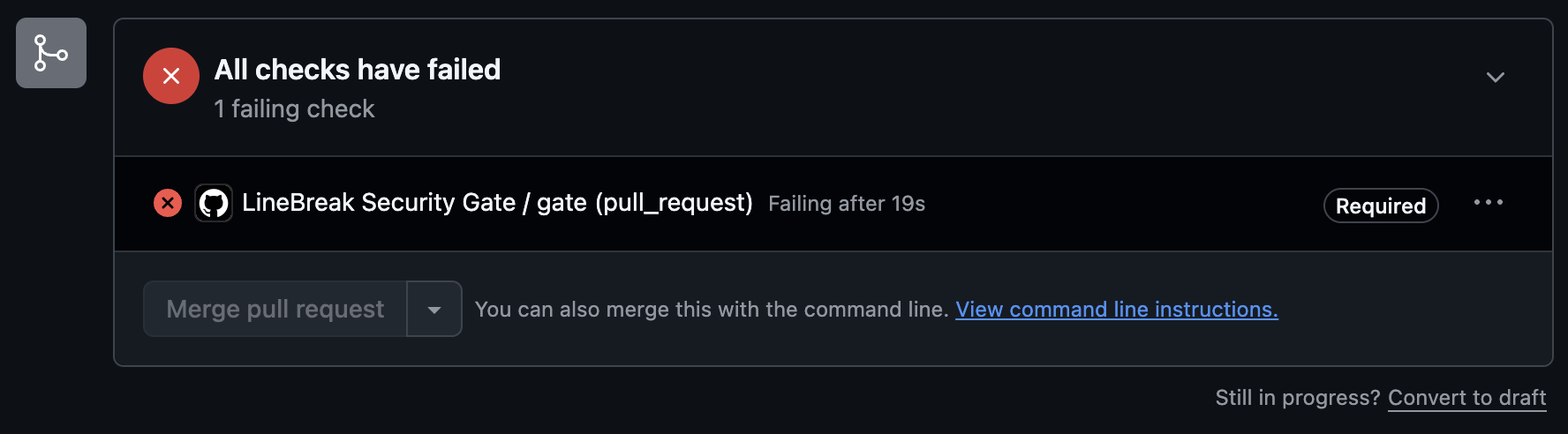
**See it live — a public PR you can open right now →**
A real recording, no mock: the scan blocks a critical CVE fail-closed, the pin gets fixed, the gate opens.

The spec loop: a named human approves the criteria, `check` blocks until the manual criterion carries a sign-off, then everything passes.

Blocks merges that carry known vulnerabilities. One tool, two detectors —
dependency scanning is free; the AI review is the Pro upgrade:
- Dependency CVE scan — free, no key — osv-scanner
across every ecosystem (npm, PyPI, Go, Cargo, Maven, …), with an `npm audit`
fallback for npm projects (npm-only coverage and no installed-version data —
the GitHub Action fails closed if osv-scanner can't be installed instead of
degrading to it).
- AI SAST — Pro — an LLM security review of first-party source (injection,
broken auth, secret exposure, SSRF, unsafe deserialization, crypto misuse)
with adversarial verification, enabled by `LINEBREAK_LICENSE_KEY` (hosted,
uses credits) or `ANTHROPIC_API_KEY` (your own key, takes precedence). Without
a key the dependency scan still runs and this pass is skipped with a notice.
The gate **blocks and can propose; it never auto-clears on an agent's
say-so**. A human approves the fix or records an override — with a reason and
an approver — in a git-committed audit file.
This is the same scanner core that powers the rest of LineBreak's in-product
security gate (the desktop backend imports this package), but it is fully
standalone: a team that has never touched anything else from LineBreak can add the gate to
their repo and get real enforcement.
> Contributing & license. This repo is the published source of
> `linebreak-gate` (Apache-2.0):
> every release lands here and on PyPI from our CI, and every change passed
> our own gate first — CVE scan and human-approved criteria, the same
> discipline we sell. Bug reports and feature requests: open an issue or
> discussion here; we read everything. Direct PRs to this repo can't be
> merged (releases flow through our review pipeline), so start with an issue
> and we'll take it from there.
Quickstart — GitHub Actions
# .github/workflows/security-gate.yml
name: Security gate
on:
  pull_request:

permissions:
  contents: read
  pull-requests: write # for the summary comment

jobs:
  gate:
    runs-on: ubuntu-latest
    steps:
      - uses: actions/checkout@v5
      - uses: Baktun-Studio/linebreak-gate@v1
        with:
          # fail-on: high # blocking floor; default: critical
          # Optional today; required once license enforcement is enabled.
          license-key: ${{ secrets.LINEBREAK_LICENSE_KEY }}
          # Enables the AI code review; leave unset for dependency scan only.
          anthropic-api-key: ${{ secrets.ANTHROPIC_API_KEY }}
The action runs `linebreak-gate scan`, always runs `report`, posts one PR
comment (updated in place on every push, never spammed), uploads the JSON
report + audit artifacts as a workflow artifact, and fails the check per the
scan's exit code.
Make it a real boundary: require the check
A CI job that can be ignored is a dashboard, not a gate. In your repo:
**Settings → Branches → Branch protection rules → your default branch →
"Require status checks to pass before merging"** → add the `gate` job (the
name of the job that runs this action). From then on a PR carrying a critical
CVE cannot be merged through the GitHub UI.
Quickstart — any other CI (GitLab example)
The CLI is a plain Python package with strict exit codes — `0` pass, `1`
blocking findings, `2` tool/config error (fail closed: a scanner crash
fails the pipeline, it is never a clean pass). Any CI that respects exit codes
gets the same enforcement:
# .gitlab-ci.yml
security-gate:
  image: python:3.11
  script:
    - pip install linebreak-gate
    - curl -fsSL -o /usr/local/bin/osv-scanner
      "$(curl -fsSL https://api.github.com/repos/google/osv-scanner/releases/latest
      | python -c "import json,sys;print(next(a['browser_download_url'] for a in json.load(sys.stdin)['assets'] if a['name'].endswith('linux_amd64')))")"
    - chmod +x /usr/local/bin/osv-scanner
    - linebreak-gate scan
    - linebreak-gate report
Mark the job as required (no `allow_failure`) and protect the branch.
The spec loop — author, approve, serve over MCP, enforce
The gate also enforces approved acceptance criteria, and the whole loop is
tool-agnostic — no LineBreak account, no desktop app, no server:
linebreak-gate spec new        # scaffold a draft — fill it with any tool (your
                               # editor, Claude Code, ChatGPT), or distill it
                               # from the PRD you already have in Notion/Jira
linebreak-gate spec approve .linebreak/spec-draft.yml \
  --approver "Ana Lopez "   # a human on the record; commits
linebreak-gate mcp install --editor claude-code   # or: cursor · codex
`linebreak-gate mcp` serves the approved bundle (`.linebreak/spec/`) over
MCP (stdio) to Claude Code, Cursor, Codex, or any MCP client. Six tools:
`list_stories`, `get_story` (criteria as agent context BEFORE code is
written), `next_story`, `set_story_status`, `check_story` (the same
evaluation engine CI runs, scoped to one story), and `spec_status` (approval +
offline signature state). Git is the transport — no network, no account,
works on a bare clone — and **nothing in the bridge can write, edit, or
invalidate an approved criterion**: criteria change only by editing the draft
and re-approving, with a human on the record.
Then `linebreak-gate check` enforces the same criteria in CI: machine checks
run for real, `manual` criteria block until a recorded sign-off. Guided first
run with the why of every step:
CLI
linebreak-gate init     [--path .] [--fail-on critical|high|medium|low] [--force] [--non-interactive]
linebreak-gate scan     [--path .] [--fail-on critical|high|medium|low] [--format summary|json]
linebreak-gate report   [--path .] [--format summary|json]
linebreak-gate override --finding  --reason "…" --approver  [--path .]
linebreak-gate override --criterion  --reason "…" --approver  [--path .]
linebreak-gate check    [--path .] [--format summary|json]
linebreak-gate signoff  --criterion  --approver  --note "…" [--path .]
linebreak-gate spec new     [--path .] [--out ] [--force]
linebreak-gate spec approve  --approver  [--role architect] [--path .]
linebreak-gate spec list|next [--path .]
linebreak-gate spec show|check  [--path .]
linebreak-gate mcp      [--path .]            # serve the approved spec over stdio
linebreak-gate mcp install [--editor claude-code|cursor|codex] [--print]
linebreak-gate badge [--format markdown|html|url]- `init` sets a repo up in one command: writes the workflow file (never
clobbers an existing one without `--force`), optionally writes
`.linebreak/gate.yml`, offers to store the secrets via the GitHub CLI and to
require the `gate` check — and prints the exact settings links for anything
it can't do for you.
- `scan` runs both detectors, writes git-native audit artifacts under
`.linebreak/audit/`, and exits 0/1/2.
- `report` renders the recorded scan: counts by severity and every finding
with CVE id, CVSS, advisory link, and override status. `--format json` for
machines.
- `override` records a human-approved acknowledgment of one exact finding
— the package + installed version + CVE tuple. A different CVE, a bumped
version, or a new finding still blocks. `--reason` and `--approver` are
required; the record lands in the artifact's approval trail. Commit the
updated `.linebreak/audit/*.json` so CI sees it.
- `check` evaluates the approved acceptance criteria (`.linebreak/spec/`,
landed by `spec approve`) against
the working tree: `build`/`tests`/`command` run for real, `manual` requires
a recorded sign-off. Exit 0 all satisfied (or no bundle — a clean no-op), 1
blocking (fail or needs-signoff), 2 tool/config/bundle error (fail closed).
Writes `.linebreak/audit/criteria.json`.
- `signoff` records an attributed human sign-off for one `manual` criterion
under `.linebreak/spec/signoffs/` (additive; `--approver` and `--note`
required). It binds to the criterion as approved — editing the criterion
and re-approving the spec makes prior sign-offs stale. Commit the record.
- `override --criterion` records a human-approved override for one failed
machine criterion in `.linebreak/audit/criteria.json` — same philosophy as
CVE overrides: possible, always attributed, stale once the criterion is
edited. Other blocking criteria still block.
- `spec new` / `spec approve` — the tool-agnostic authoring path (see the
spec-loop section above): scaffold a draft, fill it with any tool, land it
as the approved bundle with an attributed human approval, committed.
Unsigned local approvals are marked `identity_source: client`; cryptographic
signatures come from the governance service (license key).
- `spec list` prints the approved acceptance criteria bundle: each story, its
criteria with check types, and the approver attribution. Read-only. Exit 0
on a valid bundle _or when none exists_; exit 2 on a malformed bundle (fail
closed on structure). `spec next` / `show` / `check` are the CLI twins of
the MCP bridge tools.
Badge
Show visitors the repo is gated. `linebreak-gate badge` prints a ready-to-paste
README snippet (no network calls — the shields.io static badge is fully encoded
in its URL); `--format html|url` for the tag or bare-URL variants:
[](https://www.linebreakapp.com/en/gate)Configuration — `.linebreak/gate.yml`
The gate's strictness is governance, so it lives in the repo — changing the
threshold is itself a PR: visible, reviewable, attributable in git history.
# .linebreak/gate.yml
fail_on: critical # critical (default) | high | medium | low
exclude_paths: # optional: root-relative globs excluded from scanning
  - fixtures
  - "sandbox/*"
code_scan: auto # auto (run when model credentials are set) | on (required) | off
criteria:
  enforce: true # default: true whenever a spec bundle exists; false disables
  # criteria checking only (the security scan is unaffected)
Precedence: explicit `--fail-on` flag / Action input → `.linebreak/gate.yml` →
built-in default (`critical`). An invalid config is a tool error (exit 2) —
a broken governance file never silently falls back to a default.
Audit records
Every scan and every override is recorded in `.linebreak/audit/security.json`
(dependencies) and `.linebreak/audit/code.json` (AI SAST) — the same versioned
document format the LineBreak tools write, carrying findings (CVE id,
CVSS, advisory link), scanner engine, timestamp, actor, and the approval trail
with each override's reason + approver. Who relaxed the gate, and when, is
itself auditable.
Pricing
Free, forever: the dependency CVE scan and the whole spec loop — authoring,
human approval, MCP serving, and CI enforcement. No key, no account.
Pro — $99/month per team (pricing):
cryptographically signed, tamper-evident approvals (Ed25519, verifiable
offline), required-key enforcement mode, and hosted AI code review with no
API key to manage. Buy on the pricing page — your `LINEBREAK_LICENSE_KEY`
arrives by email within seconds (it's the Action's `license-key` input).
Prefer your own model key? `ANTHROPIC_API_KEY` also enables the AI review;
Pro's hosted review is the zero-config path.
The gate runs open by default: it works without a key and prints a notice
when no `LINEBREAK_LICENSE_KEY` is set (suppressed for BYOK users). That's
freemium — the dependency scan runs free. Teams that want to _require_ a valid
Pro key for the gate to run at all can opt into
`LINEBREAK_ENTITLEMENTS_PROVIDER=remote`, which checks the entitlement before
any scan and fails closed on a missing/invalid/revoked key, wrong plan, or
unreachable service — blocking the whole gate, dependency scan included.
Frequently asked questions
What is linebreak-gate?
linebreak-gate is Fail-closed CI gate for AI-written code: blocks known CVEs, enforces human-approved specs. MCP server for Claude Code/Cursor/Codex. Git-only, no server, no account.
How do I install linebreak-gate?
Open the GitHub repository and follow its README. Most MCP servers are added to your client's MCP config, then called by your agent.
Is linebreak-gate open source?
Yes — it is hosted on GitHub at https://github.com/Baktun-Studio/linebreak-gate.
Related MCP tools
 projectmem
Open-source coding agent memory. Records issues, attempts, fixes and decisions, then warns your agent before it repeats an approach that already failed. Native MCP server for Claude Code, Cursor, Antigravity and Codex. 100% local, no cloud, no telemetry. MIT.
 jcodemunch-mcp
Cut AI token costs 95%+ on code exploration. The leading MCP server for precise, symbol-level GitHub code retrieval via tree-sitter AST. Works with Claude Code, Cursor & any MCP client. 313B+ tokens saved.
 cve-mcp-server
Production-grade MCP server giving Claude 27 security intelligence tools across 21 APIs — CVE lookup, EPSS scoring, CISA KEV, MITRE ATT&CK, Shodan, VirusTotal, and more.
 google_workspace_mcp
Control Gmail, Google Calendar, Docs, Sheets, Slides, Chat, Forms, Tasks, Search & Drive with AI - Comprehensive Google Workspace MCP Server & CLI Tool
 cocoindex-code
A super light-weight embedded code search engine CLI (AST based) that just works - improves speed and efficiency for coding agent 🌟 Star if you like it!
 OpenOSINT
AI-powered OSINT agent with interactive REPL, MCP server, and CLI. 19 tools. Works with Claude, GPT-4, or local models. For authorized security research only.
Run your own MCP server? See who uses it and what to fix.
Measure it with TrackMCP