
memnest
Local-first memory for AI coding agents. One Rust service, MCP/HTTP, local hybrid search, transcript capture, and an encrypted vault.
Documentation
memnest
Your coding agent forgets the last session. Memnest keeps selected memories and conversation history on your machine, then makes them available to pi, Claude Code, Codex, and other MCP clients.




What it does
| Capability | Behavior |
|---|---|
| Durable memory | Saves decisions, preferences, corrections, facts, and rules across sessions. |
| Conversation capture | Stores visible user and assistant text after credential redaction, without LLM summarization. |
| Local search | Combines BM25 keyword matching with multilingual vector similarity. |
| Workspace scope | Keeps each directory separate, with `playbook` for rules shared everywhere. |
| Secret vault | Stores credentials in AES-256-GCM ciphertext outside searchable memory. |
A small `CLAUDE.md` or `AGENTS.md` is still the simplest place for rules that should load every time. Memnest is for material that grows across projects and sessions and should be retrieved only when it matches the current query.
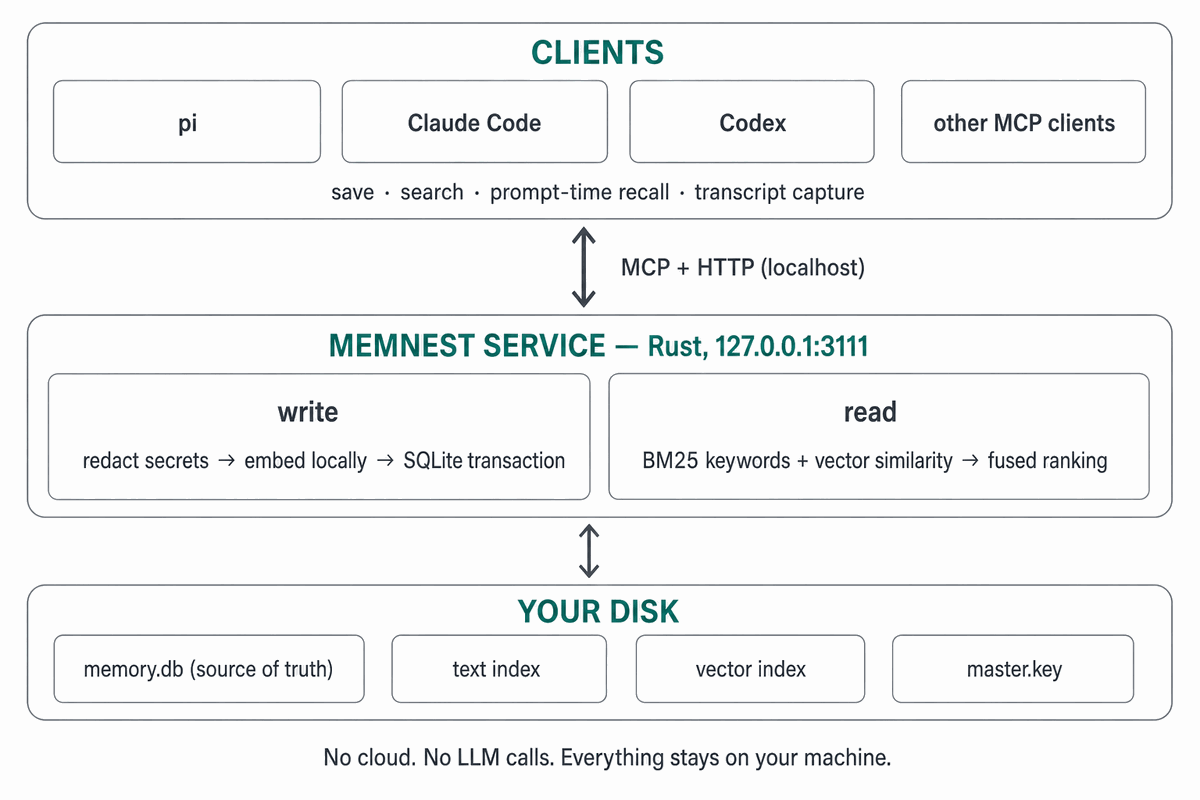
The Rust service is the only engine. SQLite is the source of truth, the search indexes are rebuildable, embeddings run locally, and no LLM is called.
Quick start
Linux x86_64 and aarch64 can install the latest release without a Rust toolchain:
curl -fsSL https://raw.githubusercontent.com/Blue-B/memnest/main/core/scripts/install.sh \
  -o /tmp/memnest-install.sh
# Review the script before running it.
bash /tmp/memnest-install.sh --user
curl -fsS http://127.0.0.1:3111/health
Windows, WSL, source builds, uninstall, backup, restore, and configuration are in the operations guide.
The first write or search downloads the local embedding model. The default model uses about 1.1 GB on disk and can approach 1.9 GB of memory while embedding.
pi
Start the core service first, then install the adapter:
pi install npm:pi-memnestThe adapter registers the memory tools, adds workspace-scoped Autocontext, and provides `/memnest` status. See the pi extension guide.
MCP
Point a Streamable HTTP MCP client at the running service:
{
  "mcpServers": {
    "memnest": { "url": "http://127.0.0.1:3111/mcp" }
  }
}
The same service also exposes a JSON HTTP API at `http://127.0.0.1:3111`. Stdio MCP and custom-host examples are in the adapter guide.
Use it
Every host uses the same five memory tools:
memory_remember
memory_search
memory_get
memory_update
memory_delete
For example, an agent can save a shared rule and find it in a later session:
memory_remember(text="Use port 5433 for staging.", project="playbook")
memory_search(query="staging database port", project="playbook")
Omit `project` when the host supplies the current working directory. That searches the current workspace plus `playbook`. Use `project=all` only for a deliberate cross-project search. Delete moves a memory to trash rather than erasing it immediately.
Vault tools are hidden from model-facing clients by default. A trusted process can opt in with `MEMNEST_EXPOSE_SECRET_TOOLS=1`.
Automatic recall and capture
`memnest hook` gives Claude Code and Codex a small context block before a prompt. It prints nothing if the service or workspace is unavailable, so it never blocks the prompt.
{
  "hooks": {
    "UserPromptSubmit": [
      { "hooks": [{ "type": "command", "command": "memnest hook" }] }
    ]
  }
}
`memnest watch` follows pi, Claude Code, and Codex transcripts and stores visible conversation text:
memnest watch
memnest watch --backfill
It skips system and developer prompts, reasoning, tool traffic, images, and subagent sidechains. Captured transcripts are retained unless deleted. Retention and recovery details are in the operations guide.
How search and storage work
flowchart LR
    W1["remember, HTTP /add, or watch"] --> W2["redact known credential shapes"]
    W2 --> W3["SQLite transaction"]
    W3 --> W4["BM25 index"]
    W3 --> W5["vector index"]

    R1["query and workspace"] --> R2["BM25 candidates"]
    R1 --> R3["vector candidates"]
    R2 --> R4["merge and rerank"]
    R3 --> R4
    R4 --> R5["results"]
Every write reaches SQLite before the derived indexes. Interrupted index work is replayed at startup, and missing indexes can be rebuilt from `memory.db`.
Three behaviors matter when using the results:
- Memnest does not read your code, so it cannot detect that a saved fact became outdated. Save the replacement with `supersedes=` when the fact changes.
- Search ranks the nearest memories. It cannot prove that the store contains an answer, so verify a result before acting on it.
- Explicit search includes captured transcripts for questions about earlier conversations. Automatic context only admits deliberate or consolidated memories, so an unfinished “tried X” note cannot silently steer the next prompt.
Data and security
The server binds to `127.0.0.1` by default. Do not expose port 3111 directly to the internet.
Regular memories are local but are not encrypted at rest. Redaction catches known credential shapes, not every possible secret, so credentials belong in the vault. Deleted records remain recoverable in trash for 30 days and may also exist in archive JSONL. Read SECURITY.md before storing sensitive material.
Back up `memory.db` together with `master.key`. The database cannot be rebuilt, while the text and vector indexes can.
Documentation
- Operations: install, configuration, retention, backup, restore, and CLI reference
- Security: threat model, vault, redaction, deletion, and network binding
- Design decisions: reasons behind the shipped architecture
- pi extension: pi setup and Autocontext behavior
- Adapters: MCP, HTTP, and custom-host integration
- Contributing: development setup and checks
Memnest is in the `0.1.x` series. Back up the database before upgrading and check the release notes for compatibility changes.
License
MIT © Blue-B
Frequently asked questions
What is memnest?
memnest is Local-first memory for AI coding agents. One Rust service, MCP/HTTP, local hybrid search, transcript capture, and an encrypted vault.
How do I install memnest?
Open the GitHub repository and follow its README. Most MCP servers are added to your client's MCP config, then called by your agent.
Is memnest open source?
Yes — it is hosted on GitHub at https://github.com/Blue-B/memnest and has 4 stars.
Related MCP tools
 iwe
iweMarkdown knowledge graph — LSP for your editor, CLI + MCP memory for your AI agents
 projectmem
Open-source coding agent memory. Records issues, attempts, fixes and decisions, then warns your agent before it repeats an approach that already failed. Native MCP server for Claude Code, Cursor, Antigravity and Codex. 100% local, no cloud, no telemetry. MIT.
 webclaw
Fast, local-first web content extraction for LLMs. Scrape, crawl, extract structured data — all from Rust. CLI, REST API, and MCP server.
 goose
goosean open source, extensible AI agent that goes beyond code suggestions - install, execute, edit, and test with any LLM
 chroma
Search infrastructure for AI
 screenpipe
YC (S26) | Open Computer History | Record your screen continuously locally and provide context to your agents (Claude, Codex, Openclaw, Hermes, Runner...)
Run your own MCP server? See who uses it and what to fix.
Measure it with TrackMCP