
dotnet-mcp-orchestrator
A .NET-native MCP orchestrator: one agent reaches many MCP servers through one server. Progressive tool discovery keeps the agent's context flat as you add servers, with an optional in-process local LLM for natural-language routing.
Documentation
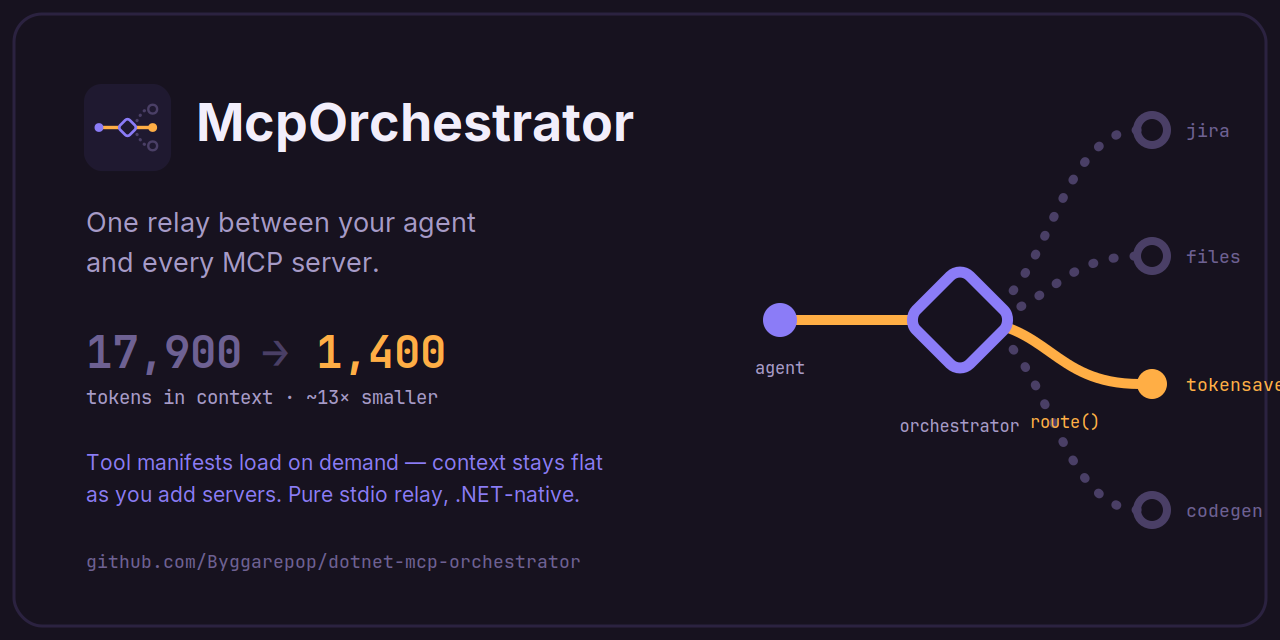
McpOrchestrator — a .NET-native MCP orchestrator



Every MCP server you connect costs context before the agent does anything — its tool manifests sit in the prompt on every turn. McpOrchestrator puts one server between your agent and all the others and loads downstream tool manifests on demand, so the agent's always-on context stays flat no matter how many servers you add. The agent sees three meta-tools — `list_capabilities` → `discover_tools` → `route` — and the orchestrator is a pure relay: it forwards exactly what the agent sends, never interpreting it. It can also serve **Agent Skills** with the same on-demand discipline.
See it in 70 seconds
https://github.com/user-attachments/assets/741c1afa-4bef-4870-9b84-e2c245b8117e
Measured impact
Against a real workplace MCP setup, measured with the Copilot CLI's `/usage`:
| Tokens in context | |
|---|---|
| MCP connected directly (manifests loaded upfront) | 17,900 |
| Same MCP behind McpOrchestrator | 1,400 |
| Reduction | ~13x |
The savings scale with the number of servers. Measure your own setup first — one command, nothing installed, not a single file changed (needs the .NET SDK):
cd ~/my-project          # a folder with a .mcp.json / .vscode/mcp.json / Cursor config
dotnet tool execute McpOrchestrator profile
Quick start
From an existing MCP setup, `cd` to the folder holding your host config (`.mcp.json`, `.vscode/mcp.json`, or a Cursor config) and run:
dotnet tool execute McpOrchestrator --yes init # dnx McpOrchestrator --yes init works tooIt lifts your stdio servers into a generated `orchestrator.config.json`, backs up the host config, and rewrites it to launch only the orchestrator. The generated catalog looks like this — one entry per downstream server:
{
  "capabilities": [
    {
      "name": "files",
      "summary": "Read and search files under the project root.", // auto-generated
      "transport": "stdio",
      "command": "npx",
      "args": ["-y", "@modelcontextprotocol/server-filesystem", "C:/projects"]
    }
    // …one entry per server init found
  ]
}
The `summary` line is what the agent routes on — refine any that read poorly. Restart your MCP host and you're done: the agent discovers everything on its own through `list_capabilities` → `discover_tools` → `route`, and every later edit to this file hot-reloads without a restart.
Add a skill
A skill is a folder with a `SKILL.md` — instructions the agent discovers and follows by itself when a task matches. Create one:
my-skills/
└── release-notes/
└── SKILL.md---
name: release-notes
description: Writes user-facing release notes from a git commit range. Use when asked for release notes or a changelog entry.
---
1. Collect the commits since the last release tag.
2. Group by user impact; drop internal-only changes.
3. One sentence per change, present tense.Point the orchestrator at the folder in `orchestrator.config.json`:
"skills": {
  "sources": [{ "id": "local", "type": "directory", "path": "C:/my-skills" }]
}
Save — it hot-reloads. The agent now sees the skill's name + one-line description via `list_skills` and loads the full instructions only when a task calls for it. Skills can also come from a shared git repo or an HTTP index, with allow/deny lists and integrity pinning — see docs/skills.md.
> Note: these skills are for the agent only — the model discovers and follows them through tools. They do not become host-native skills (no `/skills` listing or slash command in Claude Code, no IDE skill picker entry).
Documentation
Everything else lives in **McpOrchestrator/README.md and docs/**:
- How it works & the three tools — architecture and token scaling
- Profiling token economics — the `profile` command in depth, trace mode, CI gating
- CLI reference — every command and flag: the server, `init`, and `profile`, plus all environment variables
- Manual setup — the two config files `init` generates, written by hand
- Configuration reference — every field, placeholders, proactive capabilities, hot reload, central (team) configuration
- Agent Skills — sources (directory/git/HTTP), governance, delivery modes, how it works
- Packaging & Native AOT — install as a .NET tool or a self-contained binary from Releases
- How it compares — vs. mcp-aggregator and gateways, and when *not* to use this
- Troubleshooting
License
Frequently asked questions
What is dotnet-mcp-orchestrator?
dotnet-mcp-orchestrator is A .NET-native MCP orchestrator: one agent reaches many MCP servers through one server. Progressive tool discovery keeps the agent's context flat as you add servers, with an optional in-process local LLM for natural-language routing.
How do I install dotnet-mcp-orchestrator?
Open the GitHub repository and follow its README. Most MCP servers are added to your client's MCP config, then called by your agent.
Is dotnet-mcp-orchestrator open source?
Yes — it is hosted on GitHub at https://github.com/Byggarepop/dotnet-mcp-orchestrator and has 2 stars.
Related MCP tools
 Unity-MCP
AI Skills, MCP Tools, and CLI for Unity Engine. Full AI develop and test loop. Use cli for quick setup. Efficient token usage, advanced tools. Any C# method may be turned into a tool by a single line. Works with Claude Code, Gemini, Copilot, Cursor and any other absolutely for free.
 projectmem
Open-source coding agent memory. Records issues, attempts, fixes and decisions, then warns your agent before it repeats an approach that already failed. Native MCP server for Claude Code, Cursor, Antigravity and Codex. 100% local, no cloud, no telemetry. MIT.
 unity-mcp
Unity MCP acts as a bridge between AI assistants and your Unity Editor. Give your LLM tools to manage assets, control scenes, edit scripts, and automate tasks within Unity.
 firecrawl-mcp-server
🔥 Official Firecrawl MCP Server - Adds powerful web scraping and search to Cursor, Claude and any other LLM clients.
 XcodeBuildMCP
A Model Context Protocol (MCP) server and CLI that provides tools for agent use when working on iOS and macOS projects.
 semble
Fast and Accurate Code Search for Agents. Uses 99% fewer tokens than grep+read
Run your own MCP server? See who uses it and what to fix.
Measure it with TrackMCP