
diagrams-mcp
MCP server for generating cloud architecture diagrams, flowcharts, sequence diagrams, and more — powered by mingrammer/diagrams, Mermaid, and PlantUML.
Documentation
diagrams-mcp-server


MCP server for generating cloud architecture diagrams, flowcharts, sequence diagrams, and more — powered by three rendering engines: mingrammer/diagrams, Mermaid, and PlantUML.
Getting Started
Hosted (Recommended)
Connect to the public hosted server — no installation required. All rendering engines and dependencies are pre-installed.
Claude Desktop
Add to your `claude_desktop_config.json` (`Settings` → `Developer` → `Edit Config`):
{
  "mcpServers": {
    "diagrams-mcp": {
      "url": "https://diagrams-mcp-production.up.railway.app/mcp"
    }
  }
}
Claude Code (CLI)
Run:
claude mcp add diagrams-mcp https://diagrams-mcp-production.up.railway.app/mcpOr add to your `.mcp.json`:
{
  "mcpServers": {
    "diagrams-mcp": {
      "url": "https://diagrams-mcp-production.up.railway.app/mcp"
    }
  }
}
Cursor
Add to your `.cursor/mcp.json`:
{
  "mcpServers": {
    "diagrams-mcp": {
      "url": "https://diagrams-mcp-production.up.railway.app/mcp"
    }
  }
}
Windsurf
Add to your `~/.codeium/windsurf/mcp_config.json`:
{
  "mcpServers": {
    "diagrams-mcp": {
      "serverUrl": "https://diagrams-mcp-production.up.railway.app/mcp"
    }
  }
}
VS Code
Add to your `.vscode/mcp.json`:
{
  "servers": {
    "diagrams-mcp": {
      "type": "http",
      "url": "https://diagrams-mcp-production.up.railway.app/mcp"
    }
  }
}
Local Installation
Prerequisites
Graphviz is required for the default local/in-process rendering mode. Mermaid CLI and PlantUML are optional — install them only if you need those specific rendering engines locally.
| Dependency | Required for | Install |
|---|---|---|
| Graphviz | `render_diagram` (cloud architecture) | `brew install graphviz` |
| Mermaid CLI | `render_mermaid` (flowcharts, sequence, etc.) | `npm install -g @mermaid-js/mermaid-cli` |
| Java + PlantUML | `render_plantuml` (UML diagrams) | `brew install openjdk` + download plantuml.jar |
> Note: The hosted server runs as a slim MCP facade plus a separate renderer service, and has all render dependencies pre-installed in the renderer. Local prerequisites only apply if you're running in-process rendering yourself.
Install the server
Via uvx (recommended):
uvx diagrams-mcp-serverVia pip:
pip install diagrams-mcp-serverFrom source:
pip install git+https://github.com/ByteOverDev/diagrams-mcp.gitConfigure your MCP client
Claude Desktop
Add to your `claude_desktop_config.json` (`Settings` → `Developer` → `Edit Config`):
uvx (recommended):
{
  "mcpServers": {
    "diagrams-mcp": {
      "command": "uvx",
      "args": ["diagrams-mcp-server"]
    }
  }
}
pip:
{
  "mcpServers": {
    "diagrams-mcp": {
      "command": "diagrams-mcp-server"
    }
  }
}
Claude Code (CLI)
Run:
claude mcp add diagrams-mcp -- uvx diagrams-mcp-serverOr add to your `.mcp.json`:
uvx (recommended):
{
  "mcpServers": {
    "diagrams-mcp": {
      "command": "uvx",
      "args": ["diagrams-mcp-server"]
    }
  }
}
pip:
{
  "mcpServers": {
    "diagrams-mcp": {
      "command": "diagrams-mcp-server"
    }
  }
}
Cursor
Add to your `.cursor/mcp.json`:
uvx (recommended):
{
  "mcpServers": {
    "diagrams-mcp": {
      "command": "uvx",
      "args": ["diagrams-mcp-server"]
    }
  }
}
pip:
{
  "mcpServers": {
    "diagrams-mcp": {
      "command": "diagrams-mcp-server"
    }
  }
}
Windsurf
Add to your `~/.codeium/windsurf/mcp_config.json`:
uvx (recommended):
{
  "mcpServers": {
    "diagrams-mcp": {
      "command": "uvx",
      "args": ["diagrams-mcp-server"]
    }
  }
}
pip:
{
  "mcpServers": {
    "diagrams-mcp": {
      "command": "diagrams-mcp-server"
    }
  }
}
VS Code
Add to your `.vscode/mcp.json`:
uvx (recommended):
{
  "servers": {
    "diagrams-mcp": {
      "type": "stdio",
      "command": "uvx",
      "args": ["diagrams-mcp-server"]
    }
  }
}
pip:
{
  "servers": {
    "diagrams-mcp": {
      "type": "stdio",
      "command": "diagrams-mcp-server"
    }
  }
}
Available Tools
Discovery
- `list_providers()` → `list[str]` — List all diagram providers (`aws`, `gcp`, `k8s`, `azure`, `onprem`, etc.)
- `list_services(provider)` → `list[str]` — List service categories within a provider (e.g. `aws` → `compute`, `database`, `network`)
- `list_nodes(provider, service)` → `list[dict]` — List node classes for a provider.service pair with import paths
- `search_nodes(query)` → `list[dict]` — Search for nodes by keyword across all providers (e.g. "postgres", "lambda")
Rendering
- `render_diagram(code)` → `Image` (PNG) — Execute a Python script using mingrammer/diagrams in a sandboxed subprocess. Returns a rendered cloud architecture diagram.
- `render_mermaid(definition)` → `Image` (PNG/SVG) — Render a Mermaid diagram definition (flowcharts, sequence, class, ER, state, Gantt, and more).
- `render_plantuml(definition)` → `Image` (PNG) — Render a PlantUML diagram definition (sequence, class, component, activity, state, deployment).
Cross-Provider Equivalence
- `find_equivalent(node, target_provider?)` → `dict` — Find equivalent services across cloud providers (e.g. `EC2` → `ComputeEngine` on GCP).
- `list_categories()` → `list[dict]` — List all 30 infrastructure role categories with mapped nodes across providers.
Resources
The server provides reference documentation accessible via MCP resource URIs:
| URI | Description |
|---|---|
| `diagrams://reference/diagram` | Diagram constructor parameters, defaults, and usage |
| `diagrams://reference/edge` | Edge operators, labels, styling, and chaining |
| `diagrams://reference/cluster` | Cluster nesting, styling, and graph attributes |
| `diagrams://reference/mermaid` | Mermaid syntax examples for 6 diagram types |
| `diagrams://reference/plantuml` | PlantUML syntax examples for 6 diagram types |
Examples
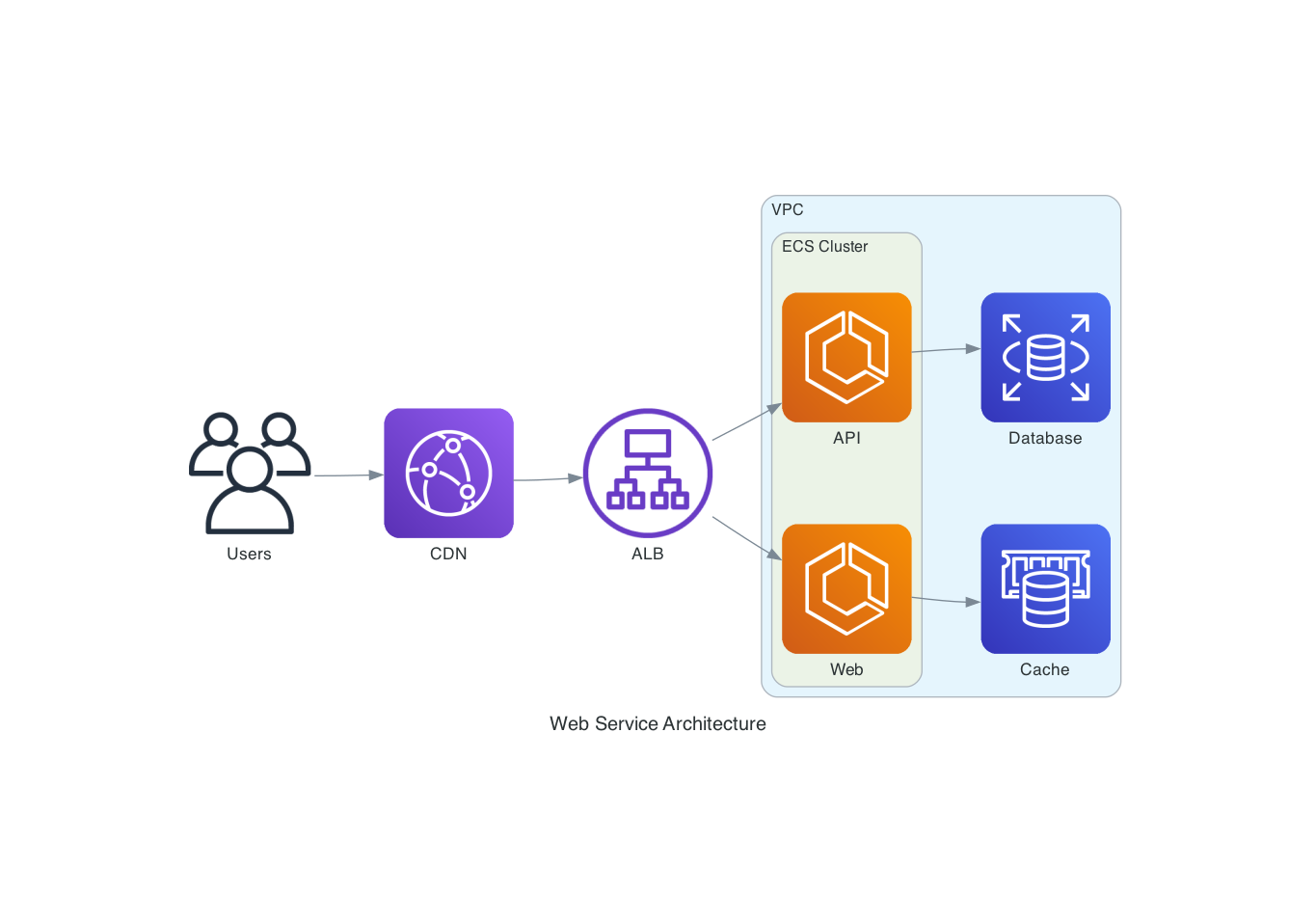
Cloud Architecture (mingrammer/diagrams)
> "Draw an AWS architecture with an ALB routing to two ECS services, backed by RDS and ElastiCache"
from diagrams import Diagram, Cluster
from diagrams.aws.network import ALB
from diagrams.aws.compute import ECS
from diagrams.aws.database import RDS, ElastiCache

with Diagram("ECS Service", direction="LR"):
    lb = ALB("ALB")

    with Cluster("ECS Cluster"):
        services = [ECS("Web"), ECS("API")]

    lb >> services
    services[0] >> ElastiCache("Cache")
    services[1] >> RDS("Database")
Flowchart (Mermaid)
> "Create a flowchart showing a CI/CD pipeline"

Sequence Diagram (PlantUML)
> "Show the authentication flow between a client, API gateway, and auth service"
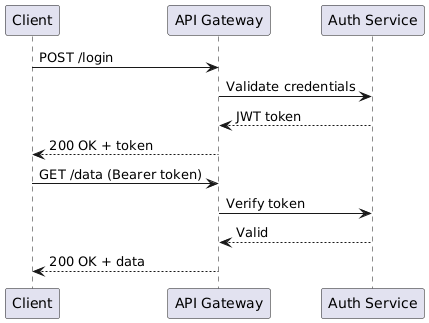
@startuml
Client -> "API Gateway": POST /login
"API Gateway" -> "Auth Service": Validate credentials
"Auth Service" --> "API Gateway": JWT token
"API Gateway" --> Client: 200 OK + token
Client -> "API Gateway": GET /data (Bearer token)
"API Gateway" -> "Auth Service": Verify token
"Auth Service" --> "API Gateway": Valid
"API Gateway" --> Client: 200 OK + data
@enduml
Development
# Clone and install
git clone https://github.com/ByteOverDev/diagrams-mcp.git
cd diagrams-mcp
pip install -e ".[dev]"

# Run tests
pytest

# Lint and format
ruff check .
ruff format .

# Run the MCP server locally (stdio mode)
diagrams-mcp-server
Split Facade/Renderer Mode
For hosted deployments, the MCP server can run as a lightweight facade that delegates render work to a separate renderer service. This keeps the always-on MCP process small while Graphviz, Chromium, Mermaid CLI, Java, and PlantUML live only in the renderer image.
# Terminal 1: renderer service
RENDERER_HOST=0.0.0.0 RENDERER_PORT=8001 diagrams-renderer-server

# Terminal 2: HTTP MCP facade delegating to the renderer
FASTMCP_TRANSPORT=http \
FASTMCP_HOST=0.0.0.0 \
FASTMCP_PORT=8000 \
DIAGRAMS_RENDERER_MODE=remote \
DIAGRAMS_RENDERER_URL=http://127.0.0.1:8001 \
diagrams-mcp-server
Docker/Railway examples are included:
| File | Purpose |
|---|---|
| `Dockerfile.facade` | Slim MCP facade image without renderer-only binaries |
| `Dockerfile.renderer` | Renderer image with Graphviz, Chromium, Mermaid CLI, Java, and PlantUML |
| `railway.facade.toml` | Example Railway facade service config |
| `railway.renderer.toml` | Example Railway renderer service config |
Key environment variables:
| Variable | Purpose |
|---|---|
| `DIAGRAMS_RENDERER_MODE=remote` | Makes the facade use the HTTP renderer service |
| `DIAGRAMS_RENDERER_URL` | Renderer base URL, for example `http://diagrams-renderer.railway.internal:8080` |
| `DIAGRAMS_IMAGE_STORE_DIR` | Optional file-backed temporary image store directory |
| `BASE_URL` | Optional public base URL used when returning absolute download links |
Supported Providers
The `render_diagram` tool supports all providers from the mingrammer/diagrams library, including:
AWS, GCP, Azure, Kubernetes, On-Premise, AlibabaCloud, OCI, OpenStack, DigitalOcean, Elastic, Outscale, Generic, and Custom nodes.
Use `list_providers()` and `search_nodes(query)` to discover available nodes.
License
MIT
Frequently asked questions
What is diagrams-mcp?
diagrams-mcp is MCP server for generating cloud architecture diagrams, flowcharts, sequence diagrams, and more — powered by mingrammer/diagrams, Mermaid, and PlantUML.
How do I install diagrams-mcp?
Open the GitHub repository and follow its README. Most MCP servers are added to your client's MCP config, then called by your agent.
Is diagrams-mcp open source?
Yes — it is hosted on GitHub at https://github.com/ByteOverDev/diagrams-mcp and has 3 stars.
Related MCP tools
 semble
Fast and Accurate Code Search for Agents. Uses 99% fewer tokens than grep+read
 google_workspace_mcp
Control Gmail, Google Calendar, Docs, Sheets, Slides, Chat, Forms, Tasks, Search & Drive with AI - Comprehensive Google Workspace MCP Server & CLI Tool
 jcodemunch-mcp
Cut AI token costs 95%+ on code exploration. The leading MCP server for precise, symbol-level GitHub code retrieval via tree-sitter AST. Works with Claude Code, Cursor & any MCP client. 313B+ tokens saved.
 paperbanana
Open source implementation and extension of Google Research’s PaperBanana for automated academic figures, diagrams, and research visuals, expanded to new domains like slide generation.
 pg-aiguide
MCP server and Claude plugin for Postgres skills and documentation. Helps AI coding tools generate better PostgreSQL code.
 MiniMax-MCP
Official MiniMax Model Context Protocol (MCP) server that enables interaction with powerful Text to Speech, image generation and video generation APIs.
Run your own MCP server? See who uses it and what to fix.
Measure it with TrackMCP