
cfbd-mcp-server
An MCP server enabling CFBD API queries within Claude Desktop.
Documentation
College Football Data MCP Server
An MCP server implementation providing access to college football statistics sourced from the College Football Data API V2 within Claude Desktop.


Overview
This Model Context Protocol (MCP) server enables AI assistants and applications to:
- Query comprehensive college football statistics and data
- Access game results, team records, and player statistics
- Analyze play-by-play data and drive summaries
- View rankings and win probability metrics
- Compare team performances and generate insights
Users can run queries using natural language.
Sample output
Q. What was the largest upset among FCS games during the 2014 season?
A. Let me help find the biggest FCS upset from 2014. I'll look through the games data, focusing on games between FCS teams where there was a significant gap in team strength and an unexpected outcome.
The data suggests there were several notable upsets in FCS during 2014, but one that stands out was Eastern Washington defeating Washington 52-59 on September 6th, 2014. This was particularly significant because:
1. Washington was an FBS team from the Pac-12 conference
2. The game was played at Washington's home stadium (Husky Stadium)
3. Eastern Washington's win probability was only 1.4% according to the post-game stats
4. The 59 points Eastern Washington scored was the most ever by an FCS team against a Pac-12 opponent
5. Washington had been favored by multiple scores going into the game
Other notable FCS upsets from that season included:
- North Dakota State defeating Iowa State 34-14
- Bethune-Cookman defeating FIU 14-12
- Northern Iowa nearly upsetting Iowa (lost 31-23)
However, Eastern Washington over Washington appears to be the largest upset of the 2014 FCS season when considering:
- The difference in divisions (FCS vs FBS)
- The caliber of the FBS opponent (Power 5 conference)
- The scoring margin and offensive performance by the underdog
- The historical significance as one of the highest-scoring FCS wins over a Power 5 team
- The fact it happened on the road in a hostile environment
Prerequisites
- Python 3.11 or higher
- UV package manager (recommended)
- A College Football Data API key (get one here)
Installation
Installing via Smithery
To install College Football Data Server for Claude Desktop automatically via Smithery:
npx -y @smithery/cli install cfbd --client claude1. Clone this repository:
git clone https://github.com/yourusername/cfbd-mcp-server
cd cfbd-mcp-server
2. Create and activate a virtual environment:
uv venv
source .venv/bin/activate  # On Windows: .venv\Scripts\activate
3. Install dependencies:
uv pip install -e .4. Create a `.env` file in the project root and add your API key:
CFB_API_KEY=your_api_key_hereManual Installation
1. Clone this repository:
git clone https://github.com/yourusername/cfbd-mcp-server
cd cfbd-mcp-server
2. Create and activate a virtual environment:
uv venv
source .venv/bin/activate  # On Windows: .venv\Scripts\activate
3. Install dependencies:
uv pip install -e .4. Create a `.env` file in the project root and add your API key:
CFB_API_KEY=your_api_key_hereUsage
Running the Server
Start the server:
uv run cfbd-mcp-serverConnecting with Claude Desktop
1. Open your Claude Desktop configuration at:
2. Add the server configuration:
{
    "mcpServers": {
        "cfbd-mcp-server": {
            "command": "uv",
            "args": [
                "--directory",
                "/full/path/to/cfbd-mcp-server",
                "run",
                "cfbd-mcp-server"
            ],
            "env": {
                "CFB_API_KEY": "xxx",
                "PATH": "/full/path/to/python"
            }
        }
    }
}
3. Close then restart Claude Desktop
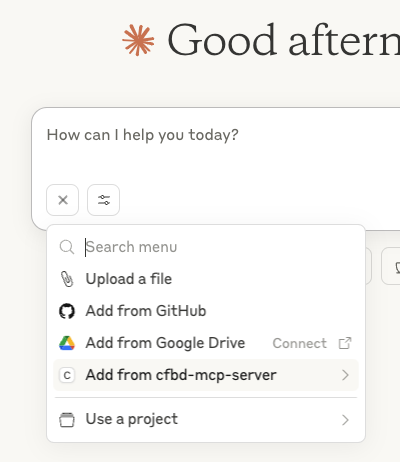
Once you restart you can confirm the installation by clicking on the plus sign in the lower left corner of the text box. If successful you'll see "Add from cfbd-mcp-server" as one of the menu options. Here's an example screenshot.
Updating after install
1. Download the updated files
cd cfbd-mcp-server
git pull
2. Uninstall the existing package:
uv pip uninstall cfbd-mcp-server3. Delete existing build artifacts and metadata
For Windows:
rmdir /s /q build dist
del /s /q *.egg-info
For macOS:
rm -rf build dist *.egg-info4. Install the revised package and its dependencies
uv pip install -e .
uv sync --dev --all-extras
5.
uv run cfbd-mcp-server6. Close and restart Claude Desktop
Features
Resources
Access schema documentation for all endpoints:
- `schema://games` - Game information and scores
- `schema://records` - Team season records
- `schema://games/teams` - Detailed team game data
- `schema://plays` - Play-by-play information
- `schema://drives` - Drive summaries and results
- `schema://play/stats` - Individual play statistics
- `schema://rankings` - Team rankings across polls
- `schema://metrics/wp/pregame` - Pregame win probabilities
- `schema://game/box/advanced` - Advanced box score statistics
Tools
Query endpoints directly:
- `get-games` - Retrieve game data
- `get-records` - Get team records
- `get-games-teams` - Access team game statistics
- `get-plays` - Query play-by-play data
- `get-drives` - Analyze drive information
- `get-play-stats` - View play statistics
- `get-rankings` - Check team rankings
- `get-pregame-win-probability` - See win probabilities
- `get-advanced-box-score` - Access detailed game statistics and analytics
Prompts
Pre-built analysis templates:
- `analyze-game` - Get detailed analysis of a specific game
- `analyze-team` - Comprehensive single team analysis
- `analyze-trends` - Analyze trends over a season
- `compare-teams` - Compare performance of two teams
- `analyze-rivalry` - Analyze historical rivalry matchups
API Limits
The College Football Data API is free to use but has rate limiting:
- Free tier: Limited requests per minute
- CFBD Patreon subscribers get higher rate limits
- Use efficient querying patterns to avoid hitting limits
- Handle rate limit errors gracefully
Development
Project Structure
cfbd-mcp-server/
├── README.md
├── pyproject.toml
└── src/
    └── cfbd_mcp_server/
        ├── .env
        ├── __init__.py
        ├── cfbd_schema.py
        ├── schema_helpers.py
        └── server.py
Setting Up for Development
1. Clone the repository
2. Install development dependencies:
uv pip install -e ".[dev]"3. Run tests:
pytestContributing
1. Fork the repository
2. Create a feature branch
3. Commit your changes
4. Push to your fork
5. Submit a pull request
Troubleshooting
Common Issues
1. API Key Errors
2. Rate Limiting
3. Connection Issues
Getting Help
- Open an issue on GitHub
- Review the API documentation
- Check the College Football Data Discord
License
This project is licensed under the MIT License - see the LICENSE file for details.
Acknowledgments
- College Football Data for providing the API
- Model Context Protocol for the MCP specification
Frequently asked questions
What is cfbd-mcp-server?
cfbd-mcp-server is An MCP server enabling CFBD API queries within Claude Desktop.
How do I install cfbd-mcp-server?
Open the GitHub repository and follow its README. Most MCP servers are added to your client's MCP config, then called by your agent.
Is cfbd-mcp-server open source?
Yes — it is hosted on GitHub at https://github.com/lenwood/cfbd-mcp-server and has 22 stars.
Related MCP tools
 chatgpt-on-wechat
基于大模型搭建的聊天机器人,同时支持 微信公众号、企业微信应用、飞书、钉钉 等接入,可选择ChatGPT/Claude/DeepSeek/文心一言/讯飞星火/通义千问/ Gemini/GLM-4/Kimi/LinkAI,能处理文本、语音和图片,访问操作系统和互联网,支持基于自有知识库进行定制企业智能客服。
 fastmcp
🚀 The fast, Pythonic way to build MCP servers and clients Trusted by 19900+ developers. Trusted by 19900+ developers. Trusted by 19900+ developers.
 upsonic
Agent Framework For Fintech for the Model Context Protocol. Enhance AI assistants with powerful integrations. Python-based implementation.
 mcp-agent
Build effective agents using Model Context Protocol and simple workflow patterns Python-based implementation. Trusted by 7600+ developers.
 minima
On-premises conversational RAG with configurable containers for the Model Context Protocol. Enhance AI assistants with powerful integrations.
 mcp-bridge
A middleware to provide an openAI compatible endpoint that can call MCP tools Python-based implementation. Trusted by 800+ developers.
Run your own MCP server? See who uses it and what to fix.
Measure it with TrackMCP