
gemini-mcp
Google Gemini MCP - Use Google's visual, video and chat capabilities in your AI Assistant. Uses MCP Apps to preview created images, landing pages, SVGs and video
Documentation
Gemini MCP - Google Gemini image generation, video and search grounding inside Claude




I've been running this Gemini MCP server in my Claude Desktop setup for months. It's one of the few I leave on permanently — not because Gemini replaces Claude, but because grounded search, image generation, SVG diagrams, and video are things Gemini does well. Having them as tools inside Claude beats switching browser tabs.
Thirteen tools, covering the models people actually come looking for: Nano Banana Pro (`gemini-3-pro-image-preview`) for image generation, Veo 3.1 for video with synchronised audio, and Gemini 3.1 Pro for chat and deep research with Google Search grounding. Images, SVGs and video preview inline in Claude Desktop through MCP Apps rather than landing as a file path you have to go and open.
One `npx` command.
> Quick Navigation
>
> Get started | What it does | SVG generation | Image output | Configuration | Tools | Models | Requirements
What it looks like
Generated images, SVGs, and videos render inline in Claude Desktop with zoom controls, file paths, and prompt context:
| Image generation | SVG / diagram generation |
|---|---|
| !Image preview | !SVG preview |
| Image embed | SVG embed | Video embed |
|---|---|---|
| !Image embed | !SVG embed | !Video embed |
Get started in two minutes
Step 1: Get a Gemini API key
Go to Google AI Studio and create one. The free tier covers most development use — you'll hit rate limits on deep research if you're hammering it, but for day-to-day work it's fine.
Step 2: Add to your Claude Desktop config
Config file locations:
- Windows: `C:\Users\{username}\AppData\Roaming\Claude\claude_desktop_config.json`
- macOS: `~/Library/Application Support/Claude/claude_desktop_config.json`
{
  "mcpServers": {
    "gemini": {
      "command": "npx",
      "args": ["@houtini/gemini-mcp"],
      "env": {
        "GEMINI_API_KEY": "your-api-key-here"
      }
    }
  }
}
Step 3: Restart Claude Desktop
That's it. Tools show up automatically. `npx` pulls the package on first run — no separate install needed.
Local build instead
For development, or if you'd rather not rely on npx:
git clone https://github.com/houtini-ai/gemini-mcp
cd gemini-mcp
npm install --include=dev
npm run build
Then point your config at the local build:
{
  "mcpServers": {
    "gemini": {
      "command": "node",
      "args": ["C:/path/to/gemini-mcp/dist/index.js"],
      "env": {
        "GEMINI_API_KEY": "your-api-key-here"
      }
    }
  }
}
Claude Code (CLI)
Claude Code uses a different registration mechanism — it doesn't read `claude_desktop_config.json`. Use `claude mcp add` instead:
claude mcp add -e GEMINI_API_KEY=your-api-key-here -s user gemini -- npx -y @houtini/gemini-mcpWith optional image output directory:
claude mcp add \
  -e GEMINI_API_KEY=your-api-key-here \
  -e GEMINI_IMAGE_OUTPUT_DIR=/path/to/output \
  -s user \
  gemini -- npx -y @houtini/gemini-mcp
Verify with `claude mcp get gemini` — you should see `Status: Connected`.
What it does
Chat with Google Search grounding
Use gemini:gemini_chat to ask: "What changed in the MCP spec in the last month?"Grounding is on by default. Gemini searches Google before answering, so you get current information rather than training cutoff answers. Sources come back as markdown links. For questions where you want pure reasoning — "explain this code" or similar — set `grounding: false`.
Supports `thinking_level` on Gemini 3 models: `high` for maximum reasoning depth, `low` to keep it fast, `medium`/`minimal` on Gemini 3 Flash only.
Deep research
Use gemini:gemini_deep_research with:
  research_question="What are the current approaches to AI agent memory management?"
  max_iterations=5
Runs multiple grounded search iterations then synthesises a full report. Takes 2-5 minutes depending on complexity — worth it for anything needing comprehensive coverage rather than a quick answer.
Set `max_iterations` to 3-4 in Claude Desktop (4-minute tool timeout). In IDEs (Cursor, Windsurf, VS Code) or agent frameworks, 7-10 iterations produces noticeably better synthesis. Pass `focus_areas` as an array to steer toward specific angles.
Image generation with search grounding
Use gemini:generate_image with:
  prompt="Stock price chart showing Apple (AAPL) closing prices for the last 5 trading days"
  use_search=true
  aspectRatio="16:9"
Default model is `gemini-3-pro-image-preview` (Nano Banana Pro). Also supports `gemini-2.5-flash-image` for faster generation.
When `use_search=true`, Gemini searches Google for current data before generating. Financial and news queries work reliably. The full-resolution image saves to disk automatically — the inline preview is resized for transport but the original is untouched.
Video generation with Veo 3.1
Use gemini:generate_video with:
  prompt="A close-up shot of a futuristic coffee machine brewing a glowing blue espresso, steam rising dramatically. Cinematic lighting."
  resolution="1080p"
  durationSeconds=8
Uses Google's Veo 3.1 model. Generates 4-8 second videos at up to 4K with native synchronised audio. Processing takes 2-5 minutes — the tool polls automatically until ready.
Options worth knowing:
- `aspectRatio` — `16:9` landscape or `9:16` portrait/vertical
- `generateAudio` — on by default, produces dialogue and sound effects matching the prompt
- `sampleCount` — generate up to 4 variations in one call
- `seed` — deterministic output across runs
- `generateThumbnail` — extracts a frame via ffmpeg (needs ffmpeg in PATH)
- `firstFrameImage` — animate from a starting image (image-to-video)
SVG generation
This is the one people underestimate. SVG output isn't just diagrams — it's production-ready vector graphics you can drop straight into a codebase, a presentation, or a web page. Clean, scalable, no raster artefacts.
Use gemini:generate_svg with:
  prompt="Architecture diagram showing a microservices system with API gateway, three services, and a shared database"
  style="technical"
  width=1000
  height=600
Four styles:
| Style | Best for |
|---|---|
| `technical` | Architecture diagrams, flowcharts, system maps |
| `artistic` | Illustrations, decorative graphics, icons |
| `minimal` | Clean data visualisations, simple charts |
| `data-viz` | Complex charts, dashboards, infographics |
The output is actual SVG code — edit it, animate it, embed it in HTML, commit it to a repo. No rasterising, no export steps, no Figma required.
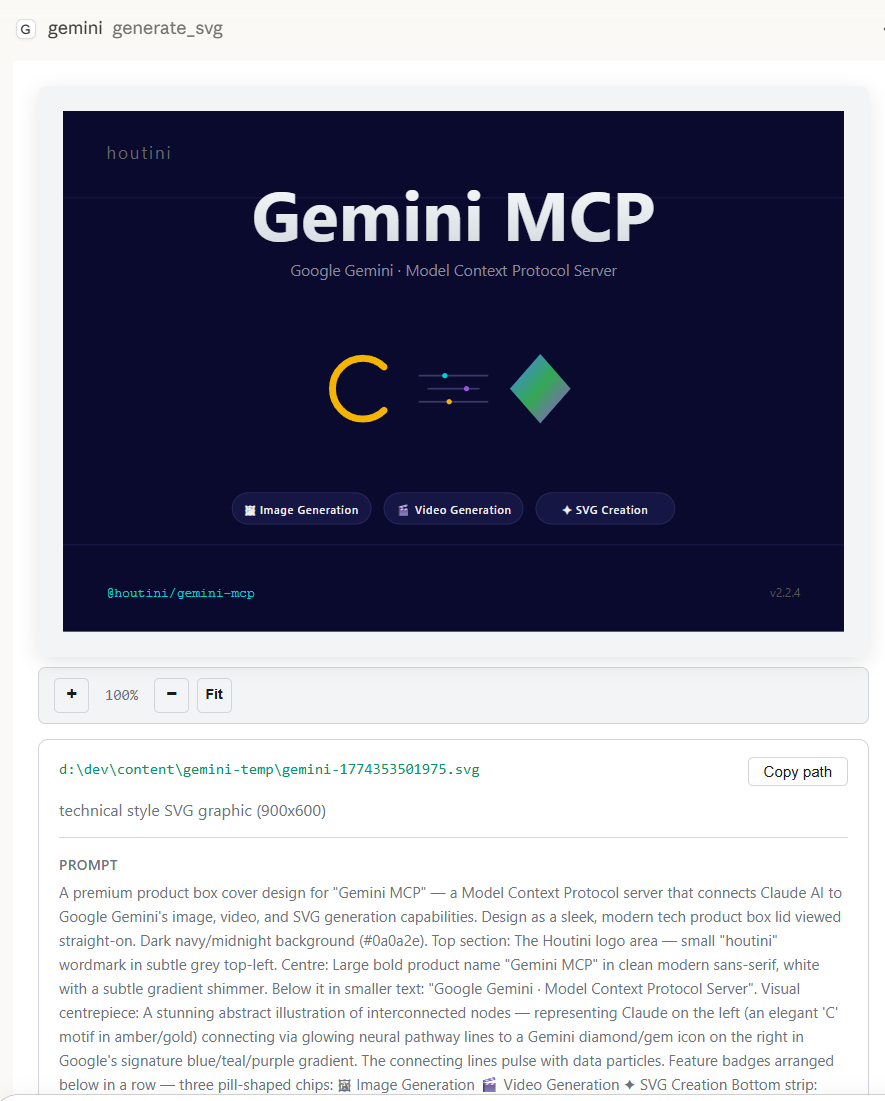
Image editing and analysis
Conversational editing — Gemini 3 Pro Image maintains context across editing turns. Pass thought signatures back on subsequent `edit_image` calls for full continuity:
Use gemini:edit_image with:
  prompt="Change the colour scheme to blue and green"
  images=[{data: imageBase64, mimeType: "image/png", thoughtSignature: "fromPreviousCall"}]
Analysis — two tools for different purposes:
- `describe_image` — Fast general descriptions using Gemini 3 Flash
- `analyze_image` — Structured extraction and detailed reasoning using Gemini 3.1 Pro
Load local files:
Use gemini:load_image_from_path with filePath="C:/screenshots/error.png"Media resolution control
Reduce token usage by up to 75% whilst maintaining quality for the task:
| Level | Tokens | Savings | Best for |
|---|---|---|---|
| `MEDIA_RESOLUTION_LOW` | 280 | 75% | Simple tasks, bulk operations |
| `MEDIA_RESOLUTION_MEDIUM` | 560 | 50% | PDFs/documents (OCR saturates here) |
| `MEDIA_RESOLUTION_HIGH` | 1120 | default | Detailed analysis |
| `MEDIA_RESOLUTION_ULTRA_HIGH` | 2000+ | per-image only | Maximum detail |
For PDF OCR, MEDIUM gives identical text extraction quality to HIGH at half the tokens.
Landing page generation
Use gemini:generate_landing_page with:
  brief="A SaaS tool that helps developers monitor API latency"
  companyName="PingWatch"
  primaryColour="#6366F1"
  style="startup"
  sections=["hero", "features", "pricing", "cta"]
Returns a self-contained HTML file — inline CSS and vanilla JS, no external dependencies. Styles: `minimal`, `bold`, `corporate`, `startup`.
Professional chart design systems
`gemini_prompt_assistant` includes 9 professional chart design systems:
| System | Inspiration | Best for |
|---|---|---|
| storytelling | Cole Nussbaumer Knaflic | Executive presentations |
| financial | Financial Times | Editorial journalism — FT Pink, serif titles |
| terminal | Bloomberg / Fintech | High-density dark mode with neon |
| modernist | W.E.B. Du Bois | Bold geometric blocks, stark contrasts |
| professional | IBM Carbon / Tailwind | Enterprise dashboards |
| editorial | FiveThirtyEight / Economist | Data journalism |
| scientific | Nature / Science | Academic rigour |
| minimal | Edward Tufte | Maximum data-ink ratio |
| dark | Observable | Modern dark mode |
Help system
Use gemini:gemini_help with topic="overview"Full documentation without leaving Claude. Topics: `overview`, `image_generation`, `image_editing`, `image_analysis`, `chat`, `deep_research`, `grounding`, `media_resolution`, `models`, `all`.
Image output and storage
By default, images return as inline previews rendered directly in Claude. Set `GEMINI_IMAGE_OUTPUT_DIR` to auto-save everything:
"env": {
  "GEMINI_API_KEY": "your-api-key-here",
  "GEMINI_IMAGE_OUTPUT_DIR": "C:/Users/username/Pictures/gemini-output"
}
The server uses a two-tier approach to handle the MCP protocol's 1MB JSON-RPC limit whilst preserving full-resolution files:
| Tier | Purpose |
|---|---|
| Full-res | Saved to disk immediately, untouched |
| Preview | Resized JPEG for inline transport — dynamically sized to fit under the cap |
Gemini returns 2-5MB images. The resize is smart — it measures the non-image overhead in each response and calculates the exact binary budget available, stepping down dimensions (800→600→400→300→200px) until it fits. The full image is always there on disk.
Configuration reference
| Variable | Required | Default | Description |
|---|---|---|---|
| `GEMINI_API_KEY` | Yes | — | Google AI API key from AI Studio |
| `GEMINI_DEFAULT_MODEL` | No | `gemini-3.1-pro-preview` | Default model for `gemini_chat` and `analyze_image` |
| `GEMINI_DEFAULT_GROUNDING` | No | `true` | Enable Google Search grounding by default |
| `GEMINI_IMAGE_OUTPUT_DIR` | No | — | Auto-save directory for generated images and videos |
| `GEMINI_ALLOW_EXPERIMENTAL` | No | `false` | Include experimental/preview models in auto-discovery |
| `GEMINI_MCP_LOG_FILE` | No | `false` | Write logs to `~/.gemini-mcp/logs/` |
| `DEBUG_MCP` | No | `false` | Log to stderr for debugging tool calls |
Tools reference
| Tool | Description |
|---|---|
| `gemini_chat` | Chat with Gemini 3.1 Pro. Google Search grounding on by default. Supports `thinking_level` |
| `gemini_deep_research` | Multi-step iterative research with Google Search. Synthesises comprehensive reports |
| `gemini_list_models` | Lists available models from the Gemini API |
| `gemini_help` | Documentation for all features without leaving Claude |
| `gemini_prompt_assistant` | Expert guidance for image generation with 9 chart design systems |
| `generate_image` | Image generation with optional search grounding. Full-res saved to disk |
| `edit_image` | Edit images with natural-language instructions. Multi-turn continuity via thought signatures |
| `describe_image` | Fast image descriptions using Gemini 3 Flash |
| `analyze_image` | Structured extraction and analysis using Gemini 3.1 Pro |
| `load_image_from_path` | Read a local image file and return base64 for any image tool |
| `generate_video` | Video generation with Veo 3.1 — 4-8 seconds at up to 4K with native audio |
| `generate_svg` | Production-ready SVG: diagrams, illustrations, icons, data visualisations |
| `generate_landing_page` | Self-contained HTML landing pages with inline CSS/JS |
Model reference
| Model | Used by | Notes |
|---|---|---|
| `gemini-3.1-pro-preview` | `gemini_chat`, `analyze_image` | Default. Advanced reasoning |
| `gemini-3-pro-image-preview` | `generate_image`, `edit_image` | Nano Banana Pro — highest quality image generation |
| `gemini-2.5-flash-image` | `generate_image` (optional) | Faster generation, higher volume |
| `gemini-3-flash-preview` | `describe_image` | Fast general descriptions |
| `veo-3.1-generate-preview` | `generate_video` | Veo 3.1 — 4K video with native audio |
Gemini 3 notes: Temperature is forced to 1.0 on Gemini 3 models (Google's requirement — lower values cause looping). Thinking level only applies to `gemini_chat`.
Token budgets: `max_tokens` defaults to each model's full output ceiling as reported live by the models API (65,536 on current Gemini 3 text models — the 1M figure is input context). It's a cap, not consumption: unused headroom costs nothing. Values below 4,096 are ignored (Gemini 3 thinking burns tiny budgets before any visible output, which looks like a timeout) and values above the model's real limit are clamped.
Requirements
- Node.js 18+
- A Gemini API key from Google AI Studio
- ffmpeg (optional, for video thumbnail extraction)
Licence
Apache-2.0
Frequently asked questions
What is gemini-mcp?
gemini-mcp is Google Gemini MCP - Use Google's visual, video and chat capabilities in your AI Assistant. Uses MCP Apps to preview created images, landing pages, SVGs and video
How do I install gemini-mcp?
Open the GitHub repository and follow its README. Most MCP servers are added to your client's MCP config, then called by your agent.
Is gemini-mcp open source?
Yes — it is hosted on GitHub at https://github.com/houtini-ai/gemini-mcp and has 31 stars.
Related MCP tools
 wigolo
The go-to web for your AI coding agent — local-first search, fetch, crawl & research over MCP. No API keys, no cloud, $0/query. Public beta.
 gemini-mcp-tool
MCP server that enables AI assistants to interact with Google Gemini CLI, leveraging Gemini's massive token window for large file analysis and codebase understanding
 Unity-MCP
AI Skills, MCP Tools, and CLI for Unity Engine. Full AI develop and test loop. Use cli for quick setup. Efficient token usage, advanced tools. Any C# method may be turned into a tool by a single line. Works with Claude Code, Gemini, Copilot, Cursor and any other absolutely for free.
 projectmem
Open-source coding agent memory. Records issues, attempts, fixes and decisions, then warns your agent before it repeats an approach that already failed. Native MCP server for Claude Code, Cursor, Antigravity and Codex. 100% local, no cloud, no telemetry. MIT.
 mcp
mcpBrowser MCP is a Model Context Provider (MCP) server that allows AI applications to control your browser
 XcodeBuildMCP
A Model Context Protocol (MCP) server and CLI that provides tools for agent use when working on iOS and macOS projects.
Run your own MCP server? See who uses it and what to fix.
Measure it with TrackMCP