
Lorekeeper
Self-improving memory for AI agents
Documentation
Lorekeeper
Self-improving memory for AI agents. One command, no cloud, no config.

> ```bash
> pip install lorekeeper-mcp && lorekeeper setup && lorekeeper
> ```
>
> Your agent remembers across sessions — and the memory gets better, not just bigger.
> Local. No API keys. No sign-up. Free to run forever.
Why Lorekeeper
Every AI agent session starts blank. You re-explain context, re-state preferences, re-teach patterns — every single time.
Files like `CLAUDE.md` and `.cursorrules` help, but they're hand-maintained, can't search themselves, and grow stale. Cloud services work, but your session data leaves your machine and you're paying per API call. Libraries are powerful, but you're writing the integration yourself.
Lorekeeper is a different shape: a local MCP server you `pip install` once. It connects to your existing agents, stores memories in SQLite on your own disk, and starts improving with every session:
Agent uses a memory → rates it useful or not →
scores adjust automatically → weak memories decay →
strong memories surface more often → search gets sharper
A fresh install and a six-month-old install are genuinely different products. The longer you use it, the less noise you get — and the more your agents feel like they actually know your codebase.
Quick Start
3 minutes, zero configuration:
# 1. Install
pip install lorekeeper-mcp

# 2. Configure your agents (auto-detects Hermes, Claude Code, Cursor)
lorekeeper setup

# 3. Start the MCP server
lorekeeper
`lorekeeper setup` scans for installed agents and injects the MCP entry, agent prompt, and bundled skills automatically. Use `--check` to preview without writing. Run `lorekeeper --help` or `lorekeeper --version` to verify the install.
Then ask your agent:
> _"Remember that I prefer `curl -vX GET` for debugging endpoints."_
It calls `lore_remember` → memory stored. Next session:
> _"What's my preferred debug command?"_
It calls `lore_search` → memory retrieved. ✅
**Full walkthrough → docs/quickstart.md**
Features
| What | How |
|---|---|
| Hybrid search | Semantic vectors + BM25 keyword + time-decay + usage frequency + memory score — all ranked by a weighted formula |
| Self-improving | `lore_update` feedback adjusts scores. Bad memories fade ( Dependency note: ~1.4GB is from the sentence-transformers embedding model (PyTorch). This is the same weight class as any local embedding solution. We're honest about it. |
MCP Tools
Lorekeeper exposes 10 MCP tools covering the full memory lifecycle:
| Tool | Purpose |
|---|---|
| `lore_search` | Hybrid semantic + keyword search with relevance scores |
| `lore_remember` | Fast one-shot memory save (auto-titles, auto-links) |
| `lore_insert` | Bulk structured insert with custom scores and links |
| `lore_update` | Feedback loop — rate memories, drive quality |
| `lore_forget` | Soft-delete wrong or outdated memories |
| `lore_reflect` | End-of-session: extract learnings, auto-save discoveries |
| `lore_processed_sessions` | Check which sessions are already processed |
| `lore_recommend_links` | Suggest candidate links between related memories |
| `lore_get_suggestions` | List pending link suggestions from the sweep engine |
| `lore_review_suggestion` | Accept or reject one or more link suggestions (batch) |
**Full API reference → docs/api-reference.md**
Dashboard
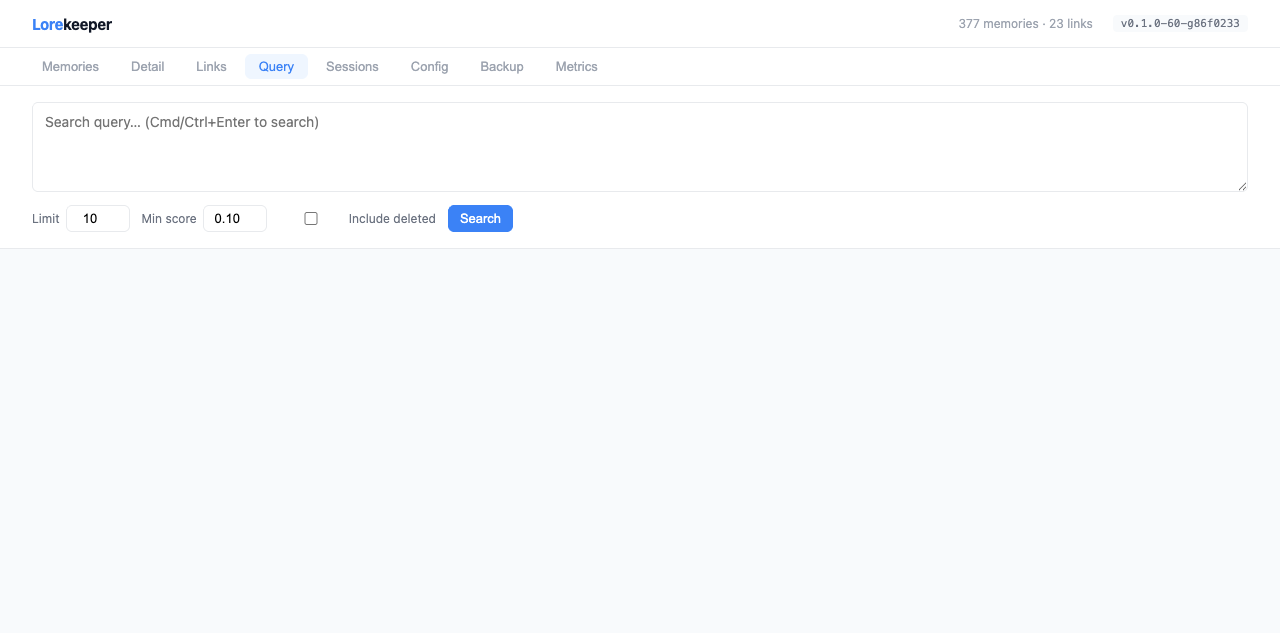
A local web UI to browse, search, edit, and manage your memory store.
lorekeeper-dashboard
# → http://127.0.0.1:7777
Seven tabs:
| Tab | What it does |
|---|---|
| Memories | Sortable table with live filter — title, score, confidence, usage, dates |
| Detail | Edit a memory's content, manage its links, soft-delete or hard-delete |
| Links | Browse the knowledge graph — source → relation → target |
| Query | Ad-hoc semantic + keyword searches with per-result score breakdown |
| Sessions | All processed agent sessions with extracted learnings |
| Config | Live tuning of search weights, quality thresholds, limits |
| Backup | Export/import memories as JSON with dedup preview |
| Suggestions | Review AI-generated link candidates from the sweep engine — accept or reject one-by-one or in bulk |
Suggestions Tab
The Suggestions tab surfaces link candidates generated automatically by the background sweep engine. Each candidate is a pair of memories the engine considers related, scored by cosine similarity, BM25 keyword overlap, entity co-occurrence, and temporal proximity.
Workflow:
1. The sweep engine runs on a configurable interval (`LORE_SUGGEST_INTERVAL_HOURS`, default `12`).
2. Candidates appear in the Suggestions tab, sorted by score (highest first).
3. Click ✓ (or select multiple rows + Accept Selected) to create a permanent link between the two memories.
4. Click ✗ (or Reject Selected) to dismiss — rejected pairs are never re-surfaced by future sweeps.
5. Use Trigger Sweep on the Config tab to run the sweep immediately instead of waiting for the interval.
Sweep configuration (via `LORE_`-prefixed env vars or the Config tab):
| Setting | Default | Description |
|---|---|---|
| `LORE_SUGGEST_INTERVAL_HOURS` | `12` | How often the sweep runs (hours) |
| `LORE_SUGGEST_MIN_SCORE` | `0.55` | Minimum weighted score to surface a candidate |
| `LORE_SUGGEST_MAX_CANDIDATES` | `500` | Maximum candidates per sweep run |
| `LORE_SUGGEST_TTL_DAYS` | `30` | Days before unreviewed suggestions are pruned |
Built by Agents, For Agents
Lorekeeper is developed _using_ AI agents — Claude Code, Hermes, and our own agent team. The development cycle is itself a working demo of what it does:
agent builds a feature → uses Lorekeeper to capture what it learned →
searches those memories next session →
builds the next feature with the context already there
This isn't a marketing line. Every tool schema, return type, and workflow in Lorekeeper was shaped by agents using it daily — not by humans reading specs. When something was annoying to use, we changed it. When search returned noise, we tuned the weights. The product is what it is because the agents that build it depend on it.
> The agentic development loop documented in this repo is how we actually work — and it's what Lorekeeper is designed to support for you.
For Developers
Clone, run from source, or contribute:
git clone https://github.com/Jessinra/Lorekeeper.git
cd Lorekeeper
bash scripts/setup.sh# Tests
uv run pytest
# Lint
uv run ruff check src tests
# Type check
uv run mypy src
# Dashboard dev
uv sync --extra dashboard
uv run lorekeeper-dashboardProject Layout
src/lorekeeper/
├── __main__.py          # Entrypoint — init_service() + mcp.run(stdio)
├── server.py            # FastMCP tool definitions (8 tools)
├── config.py            # Settings (pydantic-settings, LORE_ prefix)
├── models.py            # Pydantic models
├── dashboard/           # Web UI (FastAPI + uvicorn)
└── services/
    ├── orchestrator.py  # MemoryService — coordinates sub-services
    ├── memory_engine.py # Vector store abstraction
    ├── lancedb_engine.py# LanceDB backend
    ├── link_store.py    # SQLite — memories, links, suggestions
    ├── keyword_index.py # BM25 index
    ├── search.py        # Hybrid ranking
    └── ...
Key Configuration
All settings via `LORE_`-prefixed env vars or the dashboard Config tab:
| Variable | Default | Description |
|---|---|---|
| `LORE_DATA_DIR` | `~/.lorekeeper` | Data directory (SQLite + vectors) |
| `LORE_NAMESPACE` | `shared` | Agent namespace — writes scoped, reads union with `shared` |
| `LORE_SEARCH_LIMIT` | `5` | Default result count from `lore_search` |
| `LORE_LINK_TOP_M` | `10` | Max candidates returned by `lore_recommend_links` |
| `LORE_LINK_SCORE_THRESHOLD` | `0.3` | Minimum score for link candidates to surface |
| `LORE_LINK_TEMPORAL_TAU_DAYS` | `30` | Decay half-life for temporal proximity scoring (days) |
Full list → `src/lorekeeper/config.py` and `CLAUDE.md`.
Performance
All 500 LongMemEval-S questions, default hybrid weights (sem=0.45, kw=0.30):
| Metric | Value | Latency |
|---|---|---|
| R@1 | 84.6% | 32.9 ms/query |
| R@3 | 93.6% | |
| R@5 | 96.6% | |
| R@10 | 98.8% |
Full per-category breakdown → docs/research/2026-06-11-retrieval-benchmark-results.md
License
Apache-2.0 — see LICENSE.
_Built by agents, for agents._ Manifesto · Strategy
_Last verified: 2026-06-20_
Frequently asked questions
What is Lorekeeper?
Lorekeeper is Self-improving memory for AI agents
How do I install Lorekeeper?
Open the GitHub repository and follow its README. Most MCP servers are added to your client's MCP config, then called by your agent.
Is Lorekeeper open source?
Yes — it is hosted on GitHub at https://github.com/Jessinra/Lorekeeper and has 4 stars.
Related MCP tools
 opentabs
Browser automation clicks buttons. OpenTabs calls APIs.
 projectmem
Open-source coding agent memory. Records issues, attempts, fixes and decisions, then warns your agent before it repeats an approach that already failed. Native MCP server for Claude Code, Cursor, Antigravity and Codex. 100% local, no cloud, no telemetry. MIT.
 cognee
Cognee is the open-source AI memory platform for agents. Give your AI agents persistent long-term memory across sessions with a self-hosted knowledge graph engine.
 memorix
Open-source cross-agent memory layer for coding agents via MCP. Compatible with Claude Code, Codex, Cursor, Windsurf, Gemini CLI, Antigravity, OpenClaw, Hermes Agent, Oh-my-Pi, Pi, Copilot, Kiro, OpenCode, and Trae.
 memora
Give your AI agents persistent, collective memory — with deduplicating absorb, supersession lineage, semantic search, and a graph UI. Speaks MCP.
 hindsight
Hindsight: Agent Memory That Learns
Run your own MCP server? See who uses it and what to fix.
Measure it with TrackMCP