
tokenknows
Distill AI coding sessions (Claude Code / Codex / Cursor) into weekly reports, ADRs, incident reviews and a knowledge graph — local-first, evidence-linked.
Documentation
TokenKnows
Distill AI coding sessions into living knowledge — weekly reports, ADRs,
incident reviews, books, agent skills, and a knowledge graph.
English |
What is TokenKnows?
You spend hours pair-programming with Claude Code, Codex, and Cursor. The decisions, bug hunts, and design trade-offs from those sessions evaporate the moment the terminal closes. TokenKnows captures them automatically and distills them into structured, evidence-linked knowledge assets:
capture (6 collectors) → distill (5-stage LLM pipeline) → assets (7 document types) → review / redact / publish
- 📡 Captures everything — Claude Code, Codex, Cursor, VS Code, GitHub PRs/commits/issues, and local docs, all via local file watchers and API polling. No webhooks, no tunnels.
- 📝 Seven asset types — weekly reports, tech designs, ADRs, incident reviews, long-form books, reusable agent skills (SKILL.md), and an entity knowledge graph.
- 🔗 Evidence-linked — every paragraph traces back to the original PR / conversation / commit, ranked by `cosine × trust × recency` across ≥2 sources.
- 🔒 Local-first, zero egress by default — a three-layer LLM egress gate (instance ∧ project ∧ task) with full audit logging. Pair it with Ollama and run the whole pipeline with zero cloud keys.
Demo
| Workbench | Document page |
|---|---|
|  |  |
| Evidence drawer | Publish receipt + version diff |
|  |  |
▶ Full walkthrough: `engineering_handoff/walkthrough.mp4` (5 min, Chinese narration + subtitles)
All 12 screens
| 1 Workbench | 2 Event drawer | 3 Document list | 4 Document page |
|---|---|---|---|
|  |  |  |  |
| 5 Evidence drawer | 6 Regenerate dialog | 7 Review | 8 Redaction |
|  |  |  |  |
| 9 Publish dialog | 10 Publish receipt + diff | 11 LLM egress | 12 Admin |
|  |  |  |  |
Install the plugin
Prerequisite: the TokenKnows backend at `http://localhost:8001` and the web UI at `http://localhost:5173` (see Quick start), plus uv (the plugin pulls the MCP server from PyPI via `uvx`). All plugin env vars have working local defaults — export `TOKENKNOWS_API_BASE` / `TOKENKNOWS_API_TOKEN` / `TOKENKNOWS_DEFAULT_PROJECT` / `TOKENKNOWS_WEB_BASE` only for non-default setups. Register/login in the web UI and create an API token under Project Settings → MCP 接入 when your backend requires auth.
| Platform | How |
|---|---|
| Claude Code | `/plugin marketplace add johnnywuj81/tokenknows` → `/plugin install tokenknows@tokenknows` — full walkthrough in tokenknows-plugin/README.md (5-minute quickstart) |
| Codex | `codex plugin marketplace add johnnywuj81/tokenknows` → `codex plugin add tokenknows@tokenknows` (loads skills, commands and the MCP server; local-clone alternative in codex-plugin/README.md) |
| Cursor | Add the tokenknows MCP block to `~/.cursor/mcp.json` (uvx config example in code/tokenknows-mcp/README.md) |
| VS Code | Download the `.vsix` from Releases → `code --install-extension tokenknows-vscode-*.vsix` |
The plugin gives your AI tool MCP tools (`submit_session_events`, `distill_document`, `list_assets`, `get_asset`, `get_asset_chapters`, `search_entity`) plus slash commands like `/tokenknows:weekly` and `/tokenknows:adr`.
Quick start
# 1. (Optional but recommended) Ollama — fully local inference, zero cloud keys
ollama serve &
ollama pull minimax-m2:cloud          # or gpt-oss:20b, qwen2.5, ...

# 2. Backend (FastAPI + SQLite persistence + 3-layer LLM egress gate)
cd code/tokenknows-api
python3 -m venv .venv && .venv/bin/pip install -e ".[dev]"
cp .env.local.example .env.local      # defaults to Ollama; edit to add cloud providers
.venv/bin/uvicorn app.main:app --host 127.0.0.1 --port 8001

# 3. Frontend (React 19 + Vite)
cd code/tokenknows-web
npm install
npm run dev
# open http://localhost:5173 — talks to the real backend (mocks are opt-in via ?msw=1)

# (Optional) seed demo data
./engineering_handoff/demo-seed.sh
Platform support: macOS — full experience (collectors auto-start via launchd). Linux — backend, frontend, and collectors all run manually (`python3 plugins//sync.py --watch`); the launchd scripts don't apply. Windows — untested; WSL2 recommended.
Data collectors
All local — no ngrok, no public webhooks. On macOS they restart on crash and on reboot (launchd).
| Collector | Source | Mode |
|---|---|---|
| claude-code | `~/.claude/projects/*.jsonl` | 30s polling, incremental offsets |
| codex | `~/.codex/sessions/**/rollout-*.jsonl` | 30s polling, incremental offsets |
| cursor | Cursor's `state.vscdb` (read-only SQLite) | 60s polling |
| github | GitHub REST API · PRs / issues / commits | 5min polling (`gh auth` token) |
| vscode | VS Code extension `onDidSaveTextDocument` | buffered, 10s flush |
| local-docs | `~/Documents` `.md` `.txt` `.pdf` (watchdog) | realtime, 2s debounce |
./scripts/launchd/install.sh          # macOS: install all 5 Python collectors as LaunchAgents
launchctl list | grep com.tokenknows
tail -f ~/Library/Logs/tokenknows/*.log
Every event carries a trust score (`0.6 × source_authority + 0.4 × extraction_confidence`); the evidence stage ranks citations by `0.6 × cosine + 0.25 × trust + 0.15 × recency` and enforces ≥2 distinct sources.
Architecture
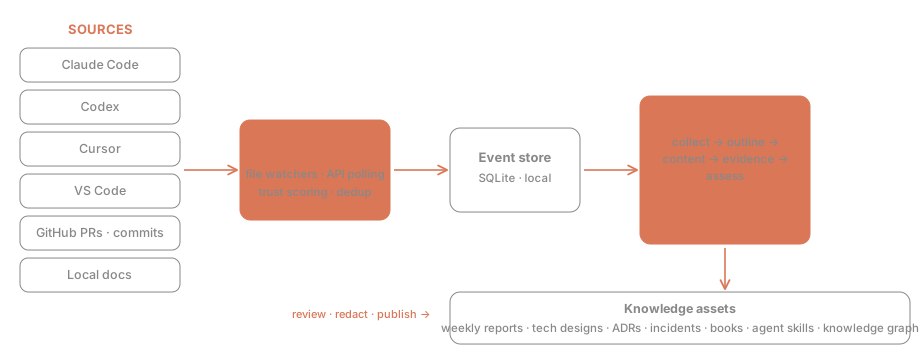
Collectors feed an event store (SQLite). A five-stage pipeline (collect → outline → content → evidence → assess) turns events into assets. The LLM Gateway unifies four providers (Anthropic / OpenAI / MiniMax / Ollama) with per-task routing and fallback chains — and refuses any cloud call unless all three egress switches are on.
CI
| Workflow | Runner | Trigger |
|---|---|---|
| `ci.yml` | ubuntu-latest (GitHub-hosted) | push to main + every PR |
| `ci-macos.yml` | self-hosted macOS ARM64 | maintainer pushes to main only — never runs external PR code |
Privacy & local-first
- Zero egress by default — cloud LLM calls require the instance and project and task switches all on
- Bring your own keys; the audit log never leaves your machine
- One-click kill switch drops the instance into fully-offline mode
Details: PRD §6.7 data residency & egress control (Chinese).
Documentation
| Topic | Doc |
|---|---|
| Product requirements, user journeys | PRD (zh) |
| Technical design, API, schema | TDD (zh) |
| Macro architecture & milestones | Architecture (zh) |
| Per-screen engineering decisions | TaskTechDesign (zh) |
| Pixel-level UI mockups | mockups/ — open in a browser |
> Most in-depth docs are in Chinese (the project's working language). Code comments are predominantly Chinese too; issues and PRs in English or Chinese are both welcome.
Community
CONTRIBUTING · Roadmap · Code of Conduct · Security policy · Issues
License
MIT © 2026 johnnywuj81
Frequently asked questions
What is tokenknows?
tokenknows is Distill AI coding sessions (Claude Code / Codex / Cursor) into weekly reports, ADRs, incident reviews and a knowledge graph — local-first, evidence-linked.
How do I install tokenknows?
Open the GitHub repository and follow its README. Most MCP servers are added to your client's MCP config, then called by your agent.
Is tokenknows open source?
Yes — it is hosted on GitHub at https://github.com/johnnywuj81/tokenknows and has 4 stars.
Related MCP tools
 projectmem
Open-source coding agent memory. Records issues, attempts, fixes and decisions, then warns your agent before it repeats an approach that already failed. Native MCP server for Claude Code, Cursor, Antigravity and Codex. 100% local, no cloud, no telemetry. MIT.
 jcodemunch-mcp
Cut AI token costs 95%+ on code exploration. The leading MCP server for precise, symbol-level GitHub code retrieval via tree-sitter AST. Works with Claude Code, Cursor & any MCP client. 313B+ tokens saved.
 auto-browser
Give your AI agent a real browser — with a human in the loop. Open-source MCP-native browser agent.
 memora
Give your AI agents persistent, collective memory — with deduplicating absorb, supersession lineage, semantic search, and a graph UI. Speaks MCP.
 atlassian-mcp-server
Official remote MCP server for Atlassian. Securely connect Jira, Confluence, Jira Service Management, Bitbucket, and Compass to Claude, ChatGPT, Cursor, VS Code, and other AI tools using OAuth 2.1 or API tokens.
 fastapi_mcp
Expose your FastAPI endpoints as Model Context Protocol (MCP) tools, with Auth! Python-based implementation. Trusted by 11000+ developers.
Run your own MCP server? See who uses it and what to fix.
Measure it with TrackMCP