
minibridge
Make your MCP servers secure and production ready
Documentation
Minibridge



Minibridge serves as a backend-to-frontend bridge, streamlining and securing
communication between Agents and MCP servers. It safely exposes [MCP
servers](https://modelcontextprotocol.io) to the internet and can optionally
integrate with generic policing services — known as Policers — for agent
authentication, content analysis, and transformation. Policers can be
implemented remotely via HTTP or locally using [OPA
Rego](https://www.openpolicyagent.org/docs/latest/policy-reference/) policies.
Minibridge can help ensure the integrity of MCP servers through
SBOM (Software Bill of Materials) generation and real-time validation.
Additionally, Minibridge supports OTEL and can
report/rettach spans from classical OTEL headers, as well as directly from the
MCP call, as inserted by certain tool like [Open
Inference](https://arize-ai.github.io/openinference).
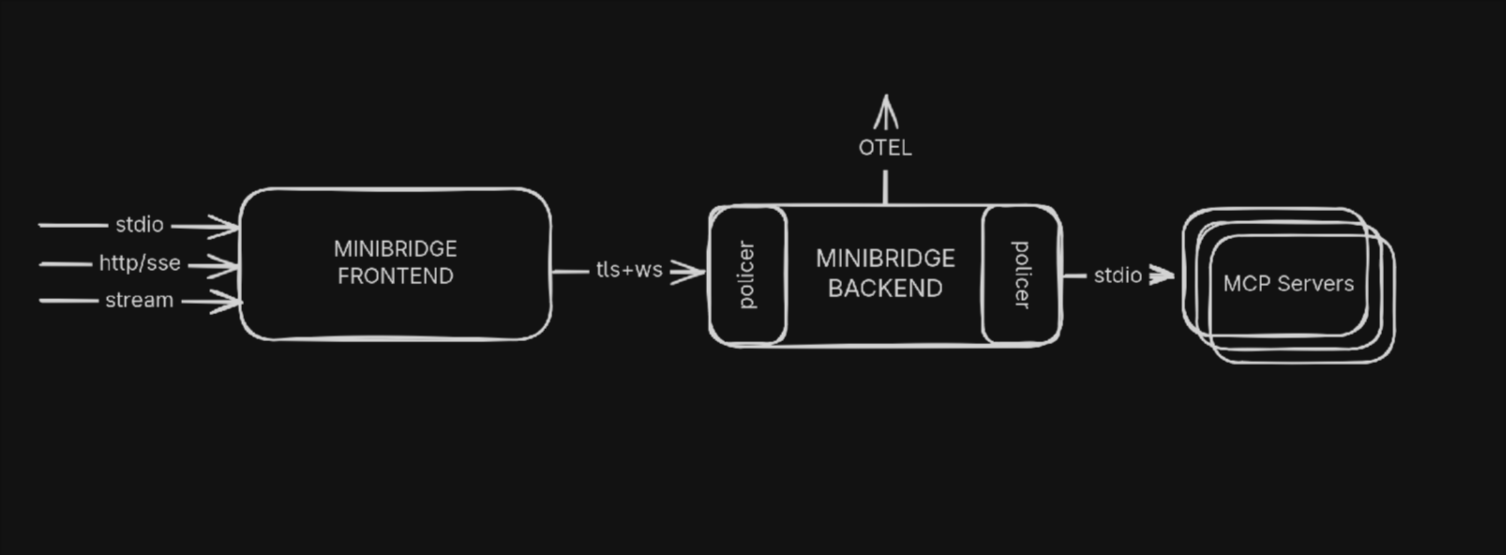
- Minibridge Frontend: The Client connects to the Frontend part of Minibridge.
- Minibridge Backend: The Frontend connects to the Backend which wraps the MCP server.
- Minibridge Policer: The Policer runs in the Backend and can optionally take decision on the input and output based on some policies (locally with Rego or remotely using HTTPs)
> [!TIP]
> Conveniently, Minibridge can be started in an "all-in-one" (AIO) mode to act as a single process.
Why using Minibridge ?
Minibridge covers the following:
- Secure Transport: Use TLS with optionally, client certificate validation
- Integrity: Ensure the MCP server can not mutate tools, templates, etc. during the execution
- User Authentication: Transport the user information to the Policer
- Monitoring: Expose prometheus metrics
- Telemetry: Report traces and spans using Opentelemetry
Installation
Minibridge can be installed from various places:
Homebrew
On macOS, you can use Homebrew
brew tap acuvity/tap
brew install minibridge
AUR
On Arch based Linux distributions, you can run:
yay -S minibridgeAlternatively, to get the latest version from the main branch:
yay -S minibridge-gitGo
If you have the Go toolchain install:
go install go.acuvity.ai/minibridge@latestAlternatively, to get the latest version from the main branch:
go install go.acuvity.ai/minibridge@mainManually
You can easily grab a binary version for your platform from the [release
page](https://github.com/acuvity/minibridge/releases/tag/v0.6.2).
Features comparisons
| 🚀 Feature | 🔹 MCP | 🔸 Minibridge | 📦 ARC (Acuvity Containers) |
|---|---|---|---|
| 🌐 Remote Access | ⚠️ | ✅ | ✅ |
| 🔒 TLS Support | ❌ | ✅ | ✅ |
| 📃 Tool integrity check | ❌ | ✅ | ✅ |
| 📊 Visualization and Tracing | ❌ | ✅ | ✅ |
| 🛡️ Isolation | ❌ | ⚠️ | ✅ |
| 🔐 Security Policy Management | ❌ | 👤 | ⚠️ |
| 🕵️ Secrets Redaction | ❌ | 👤 | ⚠️ |
| 🔑 Authorization Controls | ❌ | 👤 | 👤 |
| 🧑💻 PII Detection and Redaction | ❌ | 👤 | 👤 |
| 📌 Version Pinning | ❌ | ❌ | ✅ |
✅ _Included_ | ⚠️ _Partial/Basic Support_ | 👤 _Custom User Implementation_ | ❌ _Not Supported_
Example: Configuring Minibridge in your MCP Client
Suppose your client configuration originally specifies an MCP server like this:
{
  "mcpServers": {
    "fetch": {
      "command": "uvx",
      "args": ["mcp-server-fetch"]
    }
  }
}
To route requests through Minibridge (enabling SBOM checks, policy enforcement, etc.), update the entry:
{
  "mcpServers": {
    "fetch": {
      "command": "minibridge",
      "args": ["aio", "--", "uvx", "mcp-server-fetch"]
    }
  }
}- `minibridge aio`: Invokes Minibridge in “all-in-one” mode, wrapping the downstream tool.
- `uvx mcp-server-fetch`: The original MCP server command, now executed inside Minibridge.
> [!TIP]
> The location of the configuration files depends on your Client. For example, if you use Claude Desktop, configuration files are located:
>
> - macOS: `~/Library/Application Support/Claude/claude_desktop_config.json`
> - Windows: `%APPDATA%\Claude\claude_desktop_config.json`
>
> See the official MCP QuickStart for Claude Desktop Users documentation.
> [!IMPORTANT]
> Your client must be able to resolve the path of the binary.
> If you see an error like `MCP fetch: spawn minibridge ENOENT`, set the `command` parameter above to the full path of minibridge (`which minibridge` will give you the full path).
Documentation
Check out the complete documentation from the wiki pages.
Contribute
We are excited to welcome contributions from everyone! 🎉 Whether you're fixing bugs, enhancing features, improving documentation, or proposing entirely new ideas, your involvement helps strengthen the project and benefits the entire community.
You do not need to sign a Contributor License Agreement (CLA) — just open a pull request and let's collaborate!
Join us
Frequently asked questions
What is minibridge?
minibridge is Make your MCP servers secure and production ready
How do I install minibridge?
Open the GitHub repository and follow its README. Most MCP servers are added to your client's MCP config, then called by your agent.
Is minibridge open source?
Yes — it is hosted on GitHub at https://github.com/acuvity/minibridge and has 51 stars.
Related MCP tools
 mcptools
A command-line interface for interacting with MCP (Model Context Protocol) servers using both stdio and HTTP transport. Go-based implementation.
 toolhive
ToolHive makes deploying MCP servers easy, secure and fun Go-based implementation. Trusted by 1300+ developers. Trusted by 1300+ developers.
 slack-mcp-server
The most powerful MCP Slack Server with no permission requirements, Apps support, multiple transports Stdio and SSE, DMs, Group DMs and smart history fetch l...
 kubernetes-mcp-server
Model Context Protocol (MCP) server for Kubernetes and OpenShift Go-based implementation. Trusted by 700+ developers. Trusted by 700+ developers.
 MCPJungle
Self-hosted MCP Gateway and Registry for AI agents Go-based implementation. Trusted by 600+ developers. Trusted by 600+ developers.
 fastapi_mcp
Expose your FastAPI endpoints as Model Context Protocol (MCP) tools, with Auth! Python-based implementation. Trusted by 11000+ developers.
Run your own MCP server? See who uses it and what to fix.
Measure it with TrackMCP