
agent-eval
Statistical regression testing for LLM agents: p-value, effect size, and 95% CI on real behavior shifts vs. noise.
Documentation
Agent Evaluation




Statistical regression testing for LLM agents: run version A and version B 50x each and get a p-value, an effect size, and a 95% confidence interval on whether behavior actually shifted.
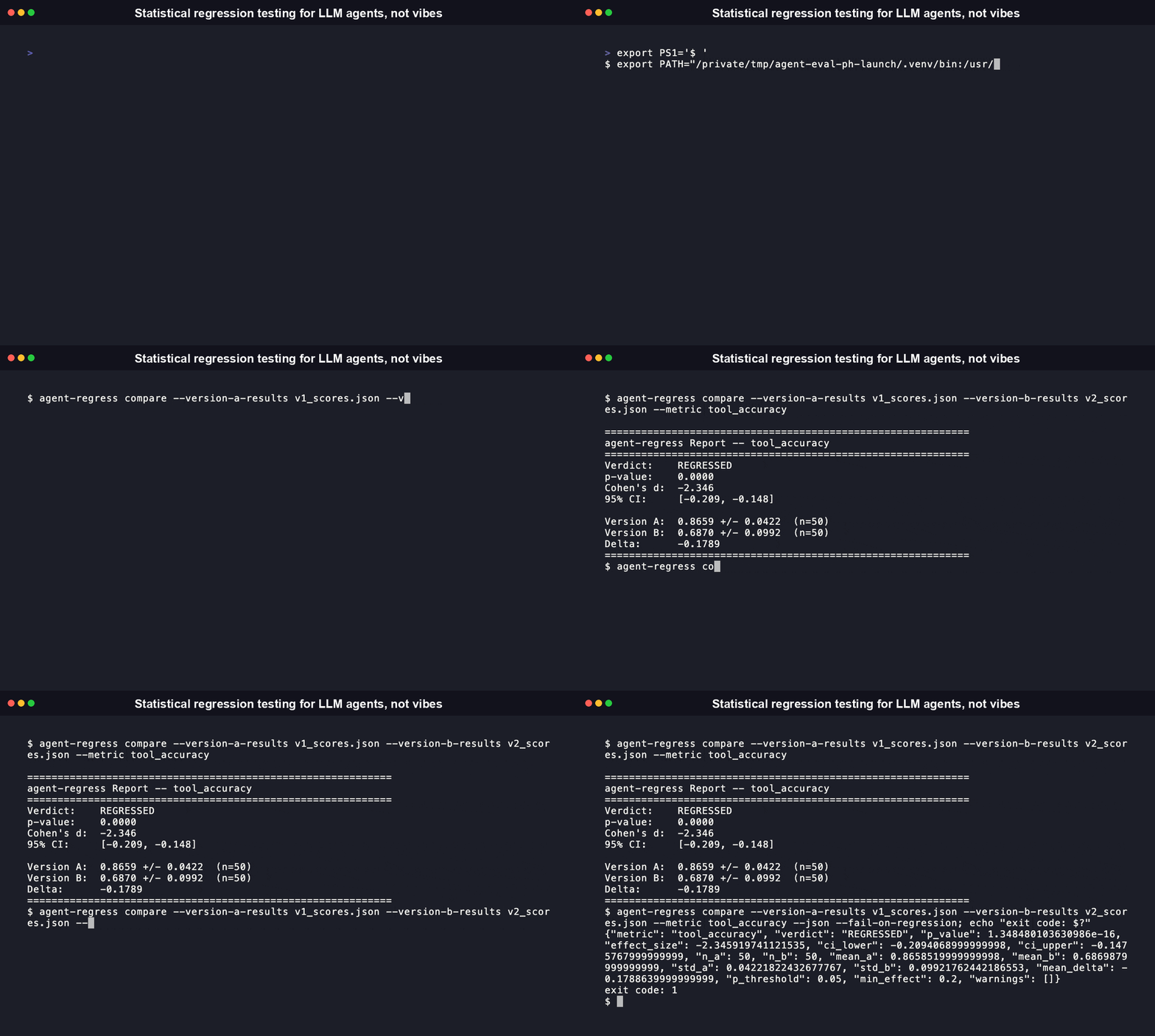
pip install agent-regress-cli(`uv add` and the npm/npx wrapper are covered in Install below.)
The test that every eval framework skips
You changed a prompt. Your evals still pass.
But your agent's tool accuracy dropped from 84% to 70%.
Is that a real regression? Or is it LLM run-to-run noise?
Threshold testing cannot answer that question.
agent-eval can.
Run your agent 50x on version A, 50x on version B.
Get a p-value, an effect size, and a 95% confidence interval
on whether behavior actually shifted.
p=0.003, Cohen's d=-0.61 -> REGRESSED (deploy blocked)
p=0.410, Cohen's d=0.021 -> STABLE (safe to ship)
> [!NOTE]
> Promptfoo, one of the most widely used open-source LLM eval frameworks, was acquired by OpenAI in March 2026, staying open source but folding its team into OpenAI's Frontier platform. agent-eval is Apache 2.0-licensed, self-hostable, and has no commercial dependency. The statistical core (Mann-Whitney U, bootstrap CI, Cohen's d) will never be paywalled.
Install
pip install agent-regress-cli
# or
uv add agent-regress-cli
# or, from Node/npx (thin wrapper around the same Python CLI)
npx agent-regress-cli
Quickstart
In 30 seconds (CLI)
Already have per-run scores from your own harness? Point the CLI at two JSON arrays of scores, one per version:
pip install agent-regress-cli

agent-regress compare \
  --version-a-results v1_scores.json \
  --version-b-results v2_scores.json \
  --metric tool_accuracy

# ============================================================
# agent-regress Report -- tool_accuracy
# ============================================================
# Verdict:    REGRESSED
# p-value:    0.0000
# Cohen's d:  -2.193
# 95% CI:     [-0.213, -0.148]
#
# Version A:  0.8470 +/- 0.0525  (n=50)
# Version B:  0.6685 +/- 0.1025  (n=50)
# Delta:      -0.1786
# ============================================================
Add `--json --fail-on-regression` to get clean, parseable output and a non-zero exit code on `REGRESSED`, for wiring straight into CI.
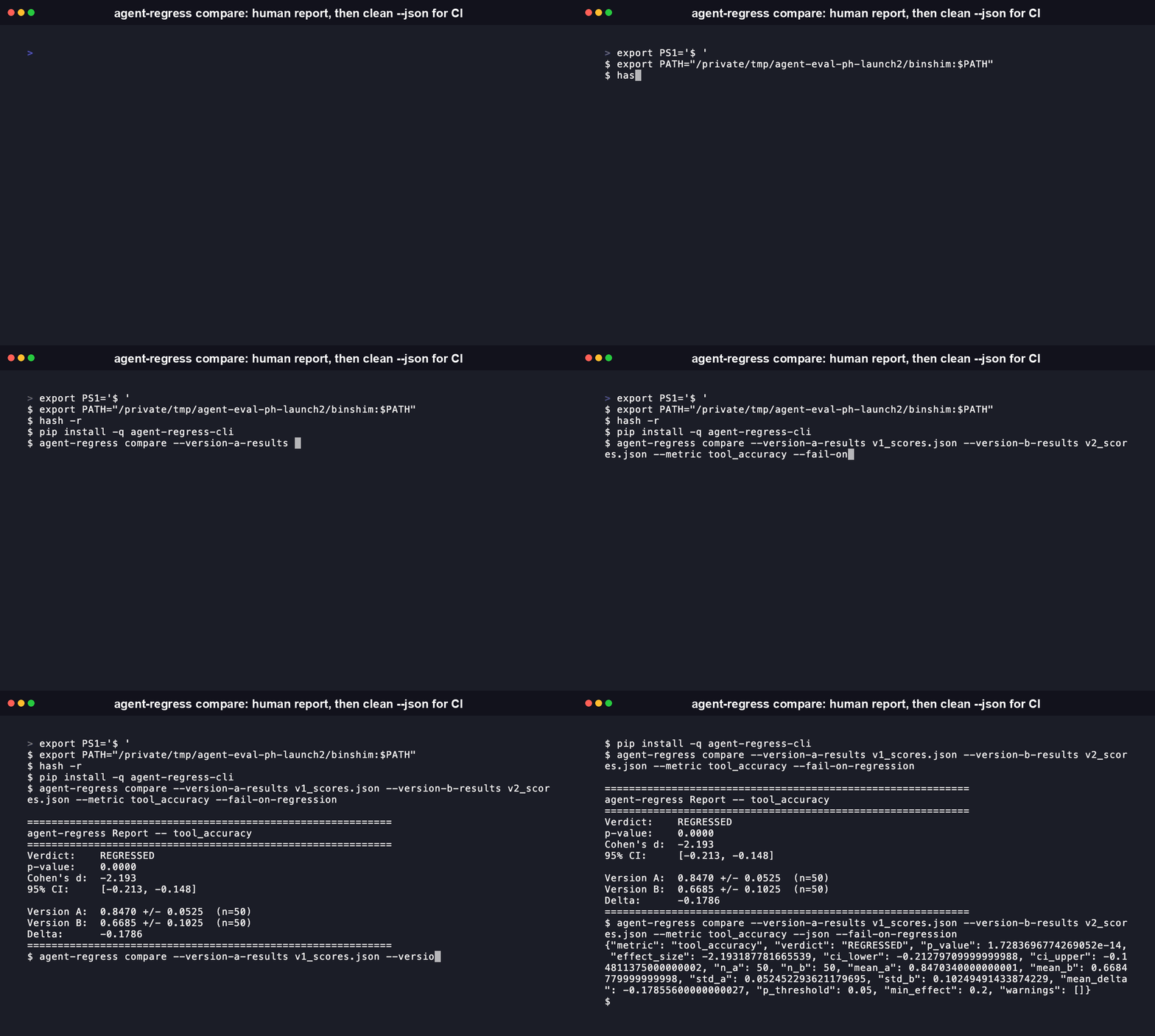
All `agent-regress compare` flags:
| Flag | Default | Description | ||
|---|---|---|---|---|
| `--version-a-results PATH` | *(required)* | Path to a JSON array of per-run scores for version A (baseline). | ||
| `--version-b-results PATH` | *(required)* | Path to a JSON array of per-run scores for version B (candidate). | ||
| `--metric NAME` | `accuracy` | Name of the metric being compared, shown in the report. | ||
| `--p-threshold P` | `0.05` | Significance threshold for the Mann-Whitney U p-value. | ||
| `--min-effect D` | `0.2` | Minimum \ | Cohen's d\ | to call a statistically significant difference REGRESSED/IMPROVED rather than STABLE. |
| `--n-resamples N` | `1000` | Number of bootstrap resamples used for the confidence interval (minimum: 100). | ||
| `--json` | off | Print the report as a single JSON object to stdout instead of the human-readable format. Warnings still go to stderr, so stdout stays clean, parseable JSON. | ||
| `--fail-on-regression` | off | Exit with status 1 if the verdict is REGRESSED (useful for CI). Without this flag, the command exits 0 regardless of verdict. |
The top-level `agent-regress --version` flag prints the installed version and exits.
Exit codes:
| Code | Meaning |
|---|---|
| `0` | Ran successfully. Verdict may be REGRESSED, STABLE, IMPROVED, or INSUFFICIENT_DATA — without `--fail-on-regression`, the exit code doesn't reflect the verdict. |
| `1` | `--fail-on-regression` was passed and the verdict is REGRESSED. |
| `2` | Usage or data error: invalid/missing arguments, no subcommand given, a `--version-*-results` file that doesn't exist or isn't valid JSON, an empty/non-numeric scores array, or an out-of-range value for `--p-threshold` (must be in `(0, 1)`), `--min-effect` (must be `>= 0`), or `--n-resamples` (must be `>= 100`). |
In your code (Python API)
Driving the agent yourself instead of pre-computing scores? Use the Python API:
from agent_regress import compare

# Any callable that takes a test case dict and returns a score 0.0-1.0
def agent_v1(test_case: dict) -> float:
    ...  # your existing agent

def agent_v2(test_case: dict) -> float:
    ...  # your updated agent

test_suite = [
    {"query": "find SKU for order 8823", "expected": "SKU-4492"},
    # ... more test cases
]

report = compare(
    version_a=agent_v1,
    version_b=agent_v2,
    test_suite=test_suite,
    n_runs=50,
    metric="tool_accuracy",  # use any name except "accuracy" when agents return floats
)

print(report)           # structured output with p-value, CI, effect size
report.assert_stable()  # raises AssertionError if behavior regressed
Agent returns text? Pass a scorer or use the built-ins:
from agent_regress import compare, exact_match_scorer, f1_scorer

# exact_match_scorer: 1.0 if str(output).strip() == str(expected).strip()
# f1_scorer: token-level F1 (multiset — handles repeated tokens correctly)
report = compare(
    version_a=agent_v1,
    version_b=agent_v2,
    test_suite=test_suite,
    n_runs=50,
    scorer=exact_match_scorer,  # test_case must have an "expected" key
)
Or write your own:
def my_scorer(output: str, test_case: dict) -> float:
    return 1.0 if output.strip() == test_case["expected"] else 0.0

report = compare(..., scorer=my_scorer)
MCP Server
agent-eval ships a Model Context Protocol server so an AI agent
(Claude, Cursor, or any MCP-compatible client) can run statistical regression tests directly,
without a human invoking the CLI by hand.
Install the extra:
pip install "agent-regress-cli[mcp]"Add it to your MCP client's config (for Claude Desktop, `claude_desktop_config.json`):
{
  "mcpServers": {
    "agent-eval": {
      "command": "uvx",
      "args": ["--from", "agent-regress-cli", "agent-regress-mcp"]
    }
  }
}
The server exposes one tool, `run`, that shells out to the `agent-regress` CLI with the given
subcommand and arguments plus `--json`, and returns the parsed JSON result:
run(["compare", "--version-a-results", "a.json", "--version-b-results", "b.json", "--metric", "accuracy"])Transport is stdio, so there is nothing to host: the MCP client spawns the server as a local
subprocess. Source: `src/agent_regress/mcp_server.py`.
Why not DeepEval, Promptfoo, or Braintrust?
| Capability | Agent Evaluation | DeepEval | Braintrust | Promptfoo |
|---|---|---|---|---|
| Statistical version comparison (p-values) | Yes | No | No | No |
| Effect size reporting (Cohen's d) | Yes | No | No | No |
| Bootstrap 95% confidence intervals | Yes | No | No | No |
| Distributional shift detection | Yes | No | No | No |
| Tau-bench pass^k harness (k=1,4,8) | Yes | No | No | No |
| GAIA Level 1-3 split harness | Yes | No | No | No |
| SWE-bench scaffold score harness | Yes | No | No | No |
| Self-hostable, zero SaaS required | Yes | Partial | No | Yes |
| Sample size warnings | Yes | No | No | No |
| Core license | Apache 2.0 | MIT | Proprietary | MIT† |
| Requires cloud account | No | Optional | Yes | No |
| Test type | Distributional | Threshold | Threshold | Threshold |
†Promptfoo acquired by OpenAI, March 2026; remains open source under its current license.
DeepEval tests whether an individual agent response clears a quality bar. Agent Evaluation tests whether behavior changed significantly between two agent versions, a different statistical question that threshold testing cannot answer. The scipy Mann-Whitney U call at the core is one line, so any SaaS eval platform can add it. What accumulates over time through production use is version-specific regression history and a community-maintained benchmark leaderboard with independent result verification.
Real regressions statistical testing catches that threshold testing misses
LangGraph
- #5243: a new typed `context=` API replaced untyped `config['configurable']`. A single run on either invocation style still clears a threshold check; only a version-A-vs-B comparison shows whether the switch changed measured behavior.
- #4486: node/task-level result caching can silently mask repeated-sampling variance. Threshold checks don't care whether a result came from cache; a statistical comparison depends on genuinely independent samples, so `agent-eval` added cache-busting to protect that assumption.
OpenAI Agents SDK
- #2463: agent-as-tool calls were silently dropping the parent run's `RunConfig`. The nested call still returns a normal-looking response, so a single-response check clears; only inspecting config propagation across runs reveals the regression.
- #2214: image/audio/file tool outputs were silently downgraded to text-only. A text-only threshold scorer has no way to notice a dropped attachment.
CrewAI
- #6134: a security fix for file tools leaking absolute filesystem paths in responses. A quality scorer checks whether the answer is correct, not whether it also leaks a path, so the leak clears the bar.
- #6236: tools gained an optional Pydantic `output_schema`, moving from unstructured `str()` output to structured JSON. Both the old and new format can look "reasonable" to a threshold scorer even though the schema changed underneath.
These are the regressions that motivated this project. Full detail on all 14 individually-documented PRs (drawn from a 29-PR, 239-row validation campaign across LangGraph, CrewAI, and the OpenAI Agents SDK) is in docs/pr-analysis.md.
The problem this solves
You changed a prompt. Or switched from GPT-4o to GPT-4o-mini to cut costs. Or a dependency updated silently. Your evals still pass, because they test individual responses against fixed thresholds. They don't detect whether behavior shifted across the whole distribution.
A 3-point drop in accuracy might be noise from LLM variance. Or it might be a real regression. Without statistical testing you cannot tell which. Teams either ignore small drops and miss real problems, or escalate everything and drown in false alarms.
Agent Evaluation answers the distributional question with a p-value and effect size:
============================================================
agent-regress Report -- tool_accuracy
============================================================
Verdict:    REGRESSED
p-value:    0.0031
Cohen's d:  -0.610
95% CI:     [-0.221, -0.067]

Version A:  0.8400 +/- 0.0601  (n=50)
Version B:  0.7000 +/- 0.0903  (n=50)
Delta:      -0.1400
============================================================
When CI fails, the assertion error gives the deploy-blocking message:
AssertionError: REGRESSED: tool_accuracy dropped 16.7%
(p=0.003, Cohen's d=-0.61, 95% CI [-0.22, -0.07])
Version A: 0.840 +/- 0.060  (n=50)
Version B: 0.700 +/- 0.090  (n=50)
When nothing changed:
Verdict:    STABLE
p-value:    0.4100
Cohen's d:  0.021
DeepEval, Promptfoo, and Braintrust test whether individual responses meet thresholds. None of them answer whether a version's behavior distribution shifted significantly from the last. Agent Evaluation addresses that specific statistical question, which threshold testing cannot answer.
Add to CI: fail the build on regression
Two patterns. Pick one.
`report.assert_stable()` — inline, after you've already called `compare()`:
# test_regression.py -- add to your existing test suite
from agent_regress import compare

def test_no_regression():
    report = compare(
        version_a=production_agent,
        version_b=staging_agent,
        test_suite=load_test_suite(),
        n_runs=50,
    )
    report.assert_stable(
        p_threshold=0.05,  # act on changes at p = 0.2.

See [docs/statistical-methods.md](docs/statistical-methods.md) for the full methodology.

---

## Benchmarks

Statistical test overhead is the time to run the comparison itself, not the agent calls. Agent calls are the bottleneck; the statistics are not.

Measured on Apple M3 Pro, Python 3.14, scipy 1.15, numpy 2.2:

| Operation | n=50 per version | n=1,000 per version |
|---|---|---|
| Mann-Whitney U | **0.34ms** | **0.47ms** |
| Bootstrap CI (1,000 resamples) | **26ms** | **31ms** |
| Full compare() statistical overhead | **~27ms** | **~32ms** |

See [docs/benchmarks.md](docs/benchmarks.md) to reproduce.

---

## Integration matrix

| Framework | Status | Install |
|---|---|---|
| LangGraph | Shipped (v0.1) | `pip install agent-regress-cli[langgraph]` |
| OpenAI Agents SDK | Shipped (v0.1) | `pip install agent-regress-cli[openai-agents]` |
| CrewAI | Shipped (v0.1) | `pip install agent-regress-cli[crewai]` |
| LangChain LCEL | Shipped (v0.1) | `pip install agent-regress-cli[langchain]` |
| AutoGen | Planned (v0.3) | |
| Vercel AI SDK (TypeScript) | Planned (v0.4) | |

Comparing two *installed versions* of the same framework (rather than two
in-process configurations)? See
[docs/cross-version-comparison.md](docs/cross-version-comparison.md) for the
`subprocess_runner()` pattern.

> [!WARNING]
> The `[crewai]` extra: CrewAI's own memory/knowledge/RAG backend can pull in ChromaDB, which currently has an unpatched critical CVE ([GHSA-f4j7-r4q5-qw2c](https://github.com/advisories/GHSA-f4j7-r4q5-qw2c)) affecting any ChromaDB server run with `trust_remote_code=True` and exposed to the network. `agent-eval` never starts, configures, or exposes a ChromaDB server itself, so this only matters if your own `Crew` does — don't run a network-exposed ChromaDB instance with `trust_remote_code=True` until a fix ships.

---

## Standard benchmarks

Agent Evaluation ships harnesses for the three standard agent benchmarks:

**Tau-bench pass^k** measures reliability across k independent attempts. Single-run benchmarks miss degradation: an agent that succeeds 60% of the time at k=1 reaches 99.93% at k=8. The k=1 vs k=8 curve is the signal.
from agent_regress.benchmarks.tau_bench import TauBenchHarness
harness = TauBenchHarness(agent=my_agent, dataset=tau_bench_dataset)
results = harness.evaluate(k_values=[1, 4, 8])
**GAIA Level 1-3 split** stratifies by task difficulty. Overall accuracy hides per-difficulty regressions: a prompt change that helps Level 1 often hurts Level 3.from agent_regress.benchmarks.gaia import GAIAHarness
harness = GAIAHarness(agent=my_agent, dataset=gaia_dataset)
results = harness.evaluate() # returns list[GAIALevelResult], one per level
for r in results:
print(f"Level {r.level}: {r.accuracy:.3f} ({r.n_correct}/{r.n_questions})")
**SWE-bench scaffold score** isolates framework contribution from model contribution.from agent_regress.benchmarks.swebench import SWEBenchHarness
harness = SWEBenchHarness(agent=my_agent, dataset=swe_dataset)
result = harness.evaluate()
print(f"scaffold pass rate: {result.scaffold_pass_rate:.3f} ({result.n_resolved}/{result.n_instances})")
See [leaderboard/README.md](leaderboard/README.md) to submit results.

---

## Try it in Docker
git clone https://github.com/RudrenduPaul/agent-eval
cd agent-eval
docker compose up
Starts two services:

- **web** (`http://localhost:8080`) — leaderboard UI served by `web/serve.py`, reading `leaderboard/results/*.json`
- **example** — runs `examples/01-basic-comparison/example.py` and prints the comparison report to stdout

Good for verifying the install works and seeing the leaderboard UI before wiring agent-regress into your own agent.

---

## Security

- **Supply chain:** Releases are built and published from a GitHub Actions workflow, signed with Sigstore, and ship with a CycloneDX SBOM attached to every GitHub Release. (No SLSA provenance attestation is generated yet — that would require adopting `slsa-framework/slsa-github-generator`.)
- **Vulnerability scanning:** Trivy scans on every CI run (HIGH/CRITICAL only, exit on unfixed). CodeQL static analysis on every push.
- **Dependency pinning:** Dependabot keeps all GitHub Actions and Python dependencies current.
- **Disclosure:** [SECURITY.md](SECURITY.md) — report vulnerabilities privately via GitHub Security Advisories.

---

## Leaderboard

The `leaderboard/` directory version-controls Tau-bench pass^k, GAIA, and SWE-bench results across models and frameworks. Submit by opening a PR with a JSON file matching `leaderboard/schema.json`. Results are independently reproduced before merging.

See [leaderboard/README.md](leaderboard/README.md).

---

## FAQ

**What is agent-eval, and what makes it different from a normal LLM eval framework?**

Agent Evaluation is a statistics library for detecting whether an agent's behavior actually changed between two versions. Run the same test suite 50 times on version A and 50 times on version B, and it reports a p-value (Mann-Whitney U), an effect size (Cohen's d), and a bootstrap 95% confidence interval on the score delta. Most eval frameworks check whether a single response clears a fixed quality threshold. Agent Evaluation instead answers a distributional question: did the score distribution shift significantly, or is a change just LLM-run-to-run noise.

**How do I install it, and which platforms does it support?**

`pip install agent-regress-cli` or `uv add agent-regress-cli`. It requires Python 3.10 through 3.13 (per the classifiers in `pyproject.toml`) and has no OS-specific code, so it runs anywhere those Python versions run. A Node/npx wrapper (`npx agent-regress-cli`, also published as `agent-regress-cli` on npm) is also available -- it shells out to this same Python package, so a Python toolchain (or `uv`/`pipx`, which can run it ephemerally without a manual `pip install` step) still needs to be available; it prints an actionable error if neither is found.

**How does it compare to DeepEval, Promptfoo, or Braintrust?**

The full breakdown is in the [comparison table](#why-not-deepeval-promptfoo-or-braintrust) above. In short: DeepEval, Promptfoo, and Braintrust all test whether an individual response clears a fixed quality bar. None of the three report a p-value, an effect size, or a bootstrap confidence interval on whether behavior shifted between two versions, which is the specific statistical question agent-eval is built to answer.

**I ran a comparison and got a warning about insufficient statistical power, or a verdict of INSUFFICIENT_DATA. What does that mean?**

The library warns (but does not fail) when either version has fewer than 50 runs, since that is the sample size needed for reliable detection of a moderate effect (Cohen's d of 0.2) at 80% power. Below 10 runs per version, it returns `INSUFFICIENT_DATA` instead of a REGRESSED/STABLE/IMPROVED verdict, since the sample is too small to trust any statistical conclusion. Re-run with `n_runs=50` or higher for a verdict you can act on.

**Does agent-eval call my LLM or manage API keys for me?**

No. `compare()` takes two callables you provide, `version_a` and `version_b`, and runs your existing agent code against your test suite. Agent Evaluation never makes a model call itself, and the stats module (`src/agent_regress/stats/`) is required to stay pure Python and scipy with no LLM calls, so the statistical core has no network dependency and nothing to configure credentials for.

**Which agent frameworks does it integrate with today?**

LangGraph, the OpenAI Agents SDK, CrewAI, and LangChain LCEL are shipped as of v0.1 (see the [integration matrix](#integration-matrix) above), each installable as an extra, e.g. `pip install agent-regress-cli[langgraph]`. AutoGen and a Vercel AI SDK (TypeScript) integration are planned but not yet shipped.

**Can I use agent-eval commercially, and what license is it under?**

Yes. It is licensed under Apache License 2.0, which permits commercial use, modification, and distribution, and includes an explicit patent grant. You need to preserve the copyright and license notices and state any changes you make; there is no warranty. See [LICENSE](LICENSE) for the full text.

---

## Contributing

- Read [CONTRIBUTING.md](CONTRIBUTING.md) before opening a PR
- Good first issues are labeled in GitHub
- Stats module (`src/agent_regress/stats/`) must stay pure Python + scipy — no LLM calls, ever
- All PRs require 95% coverage on `stats/`, 80% overall

GitHub Discussions for design questions.

Apache 2.0. Contributions welcome.

---

## Cite this work

If you use Agent Evaluation in research, please cite:
@software{paul2026agenteval,
author = {Paul, Rudrendu and Nandy, Sourav},
title = {Agent Evaluation: Statistical Regression Testing for LLM Agents},
year = {2026},
url = {https://github.com/RudrenduPaul/agent-eval},
license = {Apache-2.0}
}
---

*Built by Rudrendu Paul and Sourav Nandy*Frequently asked questions
What is agent-eval?
agent-eval is Statistical regression testing for LLM agents: p-value, effect size, and 95% CI on real behavior shifts vs. noise.
How do I install agent-eval?
Open the GitHub repository and follow its README. Most MCP servers are added to your client's MCP config, then called by your agent.
Is agent-eval open source?
Yes — it is hosted on GitHub at https://github.com/RudrenduPaul/agent-eval.
Related MCP tools
 memanto
Memory that AI Agents Love!
 langchain-mcp-adapters
LangChain 🔌 MCP Python-based implementation. Trusted by 3000+ developers. Trusted by 3000+ developers. Trusted by 3000+ developers.
 cognee
Cognee is the open-source AI memory platform for agents. Give your AI agents persistent long-term memory across sessions with a self-hosted knowledge graph engine.
 skyvern
Automate browser based workflows with AI
 hindsight
Hindsight: Agent Memory That Learns
 watermarks-remover
A privacy-first app that strips AI watermarks from content you own.
Run your own MCP server? See who uses it and what to fix.
Measure it with TrackMCP