
hyper-mcp
📦️ A fast, secure MCP server that extends its capabilities through WebAssembly plugins.
Documentation
hyper-mcp
A fast, secure MCP server that extends its capabilities through WebAssembly plugins.
What is it?
hyper-mcp makes it easy to add AI capabilities to your applications. It works with Claude Desktop, Cursor IDE, and other MCP-compatible apps. Write plugins in your favorite language, distribute them through container registries, and run them anywhere - from cloud to edge.
Features
- Write plugins in any language that compiles to WebAssembly
- Distribute plugins via standard OCI registries (like Docker Hub)
- Built on Extism for rock-solid plugin support
- Sanboxing with WASM: ability to limit network, filesystem, memory access
- Lightweight enough for resource-constrained environments
- Support all 3 protocols in the spec: `stdio`, `sse` and `streamble-http`.
- Deploy anywhere: serverless, edge, mobile, IoT devices
- Cross-platform compatibility out of the box
- Support tool name prefix to prevent tool names collision
Security
Built with security-first mindset:
- Sandboxed plugins that can't access your system without permission
- Memory-safe execution with resource limits
- Secure plugin distribution through container registries
- Fine-grained access control for host functions
- OCI plugin images are signed at publish time and verified at load time with sigstore.
Getting Started
1. Create your config file:
{
  "plugins": {
    "time": {
      "url": "oci://ghcr.io/tuananh/time-plugin:latest"
    },
    "qr_code": {
      "url": "oci://ghcr.io/tuananh/qrcode-plugin:latest"
    },
    "hash": {
      "url": "oci://ghcr.io/tuananh/hash-plugin:latest"
    },
    "myip": {
      "url": "oci://ghcr.io/tuananh/myip-plugin:latest",
      "runtime_config": {
        "allowed_hosts": ["1.1.1.1"]
      }
    },
    "fetch": {
      "url": "oci://ghcr.io/tuananh/fetch-plugin:latest",
      "runtime_config": {
        "allowed_hosts": ["*"],
        "memory_limit": "100 MB",
      }
    }
  }
}
> 📖 **For detailed configuration options including authentication setup, runtime configuration, and advanced features, see RUNTIME_CONFIG.md**
Supported URL schemes:
- `oci://` - for OCI-compliant registries (like Docker Hub, GitHub Container Registry, etc.)
- `file://` - for local files
- `http://` or `https://` - for remote files
- `s3://` - for Amazon S3 objects (requires that you have your AWS credentials set up in the environment)
2. Start the server:
$ hyper-mcp- By default, it will use `stdio` transport. If you want to use SSE, use flag `--transport sse` or streamable HTTP with `--transport streamable-http`.
- If you want to debug, use `RUST_LOG=info`.
- If you're loading unsigned OCI plugin, you need to set `insecure_skip_signature` flag or env var `HYPER_MCP_INSECURE_SKIP_SIGNATURE` to `true`
Using with Cursor IDE
You can configure hyper-mcp either globally for all projects or specifically for individual projects.
1. For project-scope configuration, create `.cursor/mcp.json` in your project root:
{
  "mcpServers": {
    "hyper-mcp": {
      "command": "/path/to/hyper-mcp"
    }
  }
}
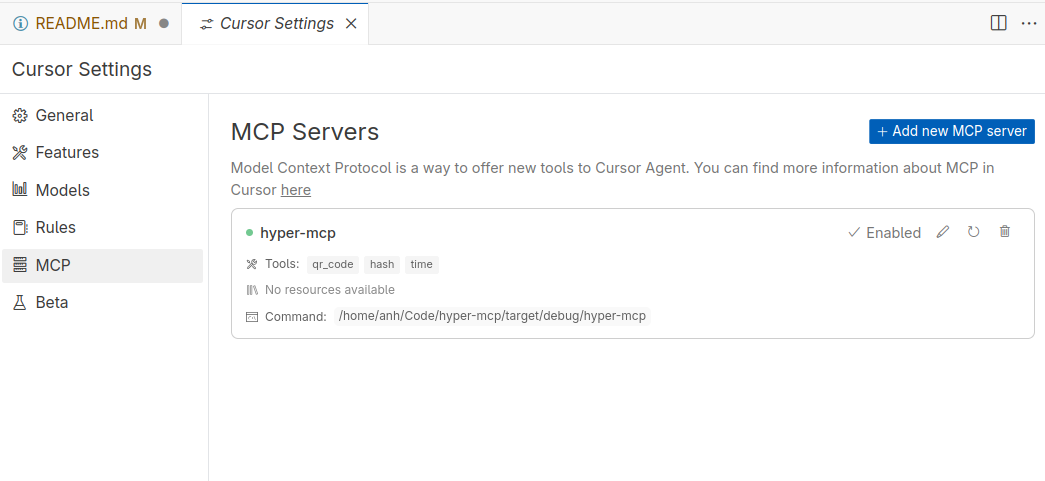
2. Set up hyper-mcp in Cursor's settings:
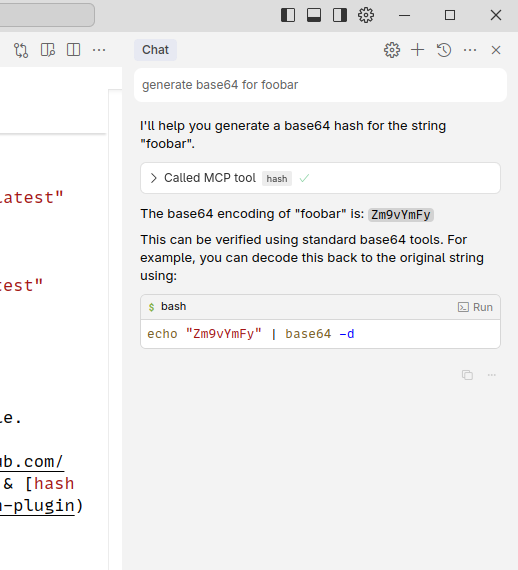
3. Start using tools through chat:
Available Plugins
We maintain several example plugins to get you started:
V1 Plugins
These plugins use the v1 plugin interface. While still supported, new plugins should use the v2 interface.
- time: Get current time and do time calculations (Rust)
- qr_code: Generate QR codes (Rust)
- hash: Generate various types of hashes (Rust)
- myip: Get your current IP (Rust)
- fetch: Basic webpage fetching (Rust)
- crypto_price: Get cryptocurrency prices (Go)
- fs: File system operations (Rust)
- github: GitHub plugin (Go)
- eval_py: Evaluate Python code with RustPython (Rust)
- arxiv: Search & download arXiv papers (Rust)
- memory: Let you store & retrieve memory, powered by SQLite (Rust)
- sqlite: Interact with SQLite (Rust)
- crates-io: Get crate general information, check crate latest version (Rust)
- gomodule: Get Go modules info, version (Rust)
- qdrant: keeping & retrieving memories to Qdrant vector search engine (Rust)
- gitlab: GitLab plugin (Rust)
- meme_generator: Meme generator (Rust)
- context7: Lookup library documentation (Rust)
- think: Think tool(Rust)
- maven: Maven plugin (Rust)
- serper: Serper web search plugin (Rust)
V2 Plugins
These plugins use the v2 plugin interface. New plugins should use this interface.
- rstime: Get current time and do time calculations (Rust)
Community-built plugins
- hackernews: This plugin connects to the Hacker News API to fetch the current top stories and display them with their titles, scores, authors, and URLs.
- release-monitor-id: This plugin retrieves project ID from release-monitoring.org, which helps track versions of released software.
- yahoo-finance: This plugin connects to the Yahoo Finance API to provide stock prices (OHLCV) based on a company name or ticker symbol.
- rand16: This plugen generates random 16 bytes buffer and provides it in base64uri format - very usable for symmetric cryptography online.
Documentation
- **Runtime Configuration Guide** - Comprehensive guide to configuration options including:
- Authentication setup (Basic, Token, and Keyring)
- Plugin runtime configuration
- Security considerations and best practices
- Platform-specific keyring setup for macOS, Linux, and Windows
- Troubleshooting authentication issues
- **Skip Tools Pattern Guide** - Comprehensive guide to filtering tools using regex patterns:
- Pattern syntax and examples
- Common use cases and best practices
- Environment-specific filtering strategies
- Advanced regex techniques
- Migration and troubleshooting
Creating Plugins
For comprehensive instructions on creating plugins, see CREATING_PLUGINS.md.
License
Star History
Frequently asked questions
What is hyper-mcp?
hyper-mcp is 📦️ A fast, secure MCP server that extends its capabilities through WebAssembly plugins.
How do I install hyper-mcp?
Open the GitHub repository and follow its README. Most MCP servers are added to your client's MCP config, then called by your agent.
Is hyper-mcp open source?
Yes — it is hosted on GitHub at https://github.com/tuananh/hyper-mcp and has 2 stars.
Related MCP tools
 goose
goosean open source, extensible AI agent that goes beyond code suggestions - install, execute, edit, and test with any LLM
 chroma
Search infrastructure for AI
 screenpipe
YC (S26) | Open Computer History | Record your screen continuously locally and provide context to your agents (Claude, Codex, Openclaw, Hermes, Runner...)
 fff
fffThe fastest and the most accurate file search SDK for AI agents, Neovim, Rust, C, Python, Bun and NodeJS
 sem
semSemantic version control => entity-level diffs, blame, and impact analysis on top of git. 28 languages via tree-sitter. Built for coding agents.
 webclaw
Fast, local-first web content extraction for LLMs. Scrape, crawl, extract structured data — all from Rust. CLI, REST API, and MCP server.
Run your own MCP server? See who uses it and what to fix.
Measure it with TrackMCP