
sinch-mcp-server
Exposing Sinch's APIs as MCP Tools
Documentation
Sinch MCP Server — Developer Preview

This repository contains the source code for the Sinch MCP server, which provides a set of tools to interact with the Sinch APIs. This README focuses on using the MCP server with the Claude Desktop client, but it can also be used with any other MCP client.
Tools Overview
Here is the list of tools available in the MCP server (all the phone numbers must be provided in E.164 format, e.g., `+33612345678` for France).
Conversation Tools
| Tool | Description | Tags |
|---|---|---|
| send-text-message | Send a plain text message to a recipient on a supported channel. _Example prompt_: "Send a quick update to the phone number +33612345678 on SMS." | conversation, notification |
| send-media-message | Send an image, video, or document via a media message. _Example prompt_: "Send the product brochure PDF to the phone number +33612345678 on WhatsApp." | conversation, notification |
| send-template-message | Send a message using a predefined template (omni-template only). _Example prompt_: "Send the appointment reminder template in Spanish to this user on Messenger." | conversation, notification |
| send-whatsapp-template-message | Send a message using a predefined WhatsApp template. _Example prompt_: "Send a message using the template "appointment-reminder" on WhatsApp." | conversation, notification |
| send-choice-message | Send a message that includes interactive choices (buttons or quick replies). _Example prompt_: "Send a RCS survey about preferred ice cream flavor to +33612345678 with the following choices: Vanilla, Strawberry, Hazelnut". | conversation, notification |
| send-location-message | Send a location pin or coordinates to a user. _Example prompt_: "Send a pin to the Guggenheim Museum location in Bilbao to the phone number +33612345678." | conversation, notification |
| list-conversation-apps | List all configured Conversation apps in the Sinch account. _Example prompt_: "What messaging apps do I have set up in my account?" | conversation, notification |
| create-conversation-app | Create a new Conversation API app (no channels required at creation). _Example prompt_: "Create a Conversation app named My Support Bot in the EU region." | conversation, configuration |
| update-conversation-app | Update a Conversation API app display name. _Example prompt_: "Rename Conversation app abc123 to My Support Bot." | conversation, configuration |
| delete-conversation-app | Delete a Conversation API app by ID. _Example prompt_: "Delete Conversation app abc123." | conversation, configuration |
| set-sms-channel-on-app | Set (create or replace) the SMS channel on a Conversation app. _Example prompt_: "Set SMS on app abc123 using service plan XYZ and API token …" | conversation, configuration |
| set-rcs-channel-on-app | Set (create or replace) the RCS channel on a Conversation app. _Example prompt_: "Set RCS on app abc123 with sender ID … and bearer token …" | conversation, configuration |
| set-whatsapp-channel-on-app | Set (create or replace) the WhatsApp channel on a Conversation app. _Example prompt_: "Set WhatsApp on app abc123 with sender ID … and bearer token …" | conversation, configuration |
| list-messaging-templates | List the omni-channel message templates (managed by Sinch) for the configured region. WhatsApp-specific templates can be fetched with the `list-whatsapp-templates` tool. _Example prompt_: "Show me all message templates in my account." | conversation, notification |
| list-webhooks | List webhooks configured for a Conversation app. _Example prompt_: "List all webhooks for my Conversation app." | conversation, configuration |
| get-webhook | Get a webhook by ID. _Example prompt_: "Show me the details of webhook ID abc123." | conversation, configuration |
| create-webhook | Create a webhook that delivers Conversation API events to a target URL. _Example prompt_: "Create a webhook for inbound messages at https://example.com/callback." | conversation, configuration |
| update-webhook | Update a webhook target URL and/or triggers. _Example prompt_: "Update webhook abc123 to also receive MESSAGE_DELIVERY events." | conversation, configuration |
| delete-webhook | Delete a webhook by ID. _Example prompt_: "Delete webhook abc123." | conversation, configuration |
Email tools (Mailgun)
| Tool | Description | Tags |
|---|---|---|
| send-email | Send an email using a predefined HTML template or raw HTML/text content. _Example prompt_: "Send a welcome email to john@example.com using our onboarding template." | email, notification |
| list-email-templates | List all email templates available for a specific domain. _Example prompt_: "What email templates do I have available?" | email, notification |
| retrieve-email-info | Retrieve metadata, content and delivery status for a specific email message. _Example prompt_: "Can you get the delivery status of the email with ID ?" | email, notification |
| list-email-events | Retrieve and group recent email delivery events, such as bounces, opens, or clicks. _Example prompt_: "Show me all recent email activity for my account." | |
| analytics-metrics | Retrieve email analytics metrics, such as open rates or click-through rates. _Example prompt_: "What are the open rates during the last week?" |
Verification Tools
| Tool | Description | Tags |
|---|---|---|
| number-lookup | Lookup a phone number for its status and capabilities. _Example prompt_: "Lookup for the following phone number capabilities: +33501020304." | verification |
| start-sms-verification | Initiate an SMS verification by sending an OTP to a user's phone number. _Example prompt_: "Start phone verification for the number +33612345678." | verification |
| report-sms-verification | Submit a one-time password (OTP) to complete SMS verification. _Example prompt_: "Verify the phone number with this code: 1234." | verification |
Voice Tools
| Tool | Description | Tags |
|---|---|---|
| tts-callout | Place a voice call and read aloud a message using Text-to-Speech. _Example prompt_: "Call the phone number +33612345678 and say: 'Your appointment is tomorrow at 10 AM.'" | voice, notification |
| conference-callout | Start a voice call to one or more participants and connect them to a shared conference. _Example prompt_: "Call John (+33612345678) and Lisa (+34987654321) and connect them to a conference room." | voice |
| manage-conference-participant | Mute, unmute, hold, or resume an individual participant in a conference call. _Example prompt_: "Mute the caller with ID xyz789 in the conference." | voice |
| close-conference | End a conference call by disconnecting all the participants using the ID of the conference. _Example prompt_: "End the current conference call with ID abc123." | voice |
| get-call-information | Get information about a call using its ID. _Example prompt_: "Get the details of call ID abc123." | voice, notification |
RCS Sender Tools
| Tool | Description | Tags |
|---|---|---|
| list-rcs-senders | List all RCS senders for the project, with pagination support. _Example prompt_: "Show me all my RCS senders." | rcs, configuration |
| get-rcs-sender | Get a full RCS sender by ID, including credentials, state, brand details, test numbers, and country status. _Example prompt_: "Get the details of my RCS sender abc123." | rcs, configuration |
| create-rcs-sender | Create a new RCS sender. Brand details, questionnaire, and countries can be provided upfront or added incrementally via update-rcs-sender. _Example prompt_: "Create an RCS sender for the EU region with a CONVERSATIONAL billing category." | rcs, configuration |
| update-rcs-sender | Update an RCS sender's brand, countries, test numbers, or questionnaire. _Example prompt_: "Update my RCS sender abc123 with the brand logo URL." | rcs, configuration |
| launch-rcs-sender | Submit an RCS sender for Google and carrier review. All brand details, countries, and questionnaire sections must be complete before launching. _Example prompt_: "Launch my RCS sender abc123." | rcs, configuration |
| add-rcs-test-number | Add test phone numbers to an RCS sender (max 20 per request, 200 total per sender). _Example prompt_: "Add +14155552671 as a test number to my RCS sender." | rcs, configuration |
| delete-rcs-test-number | Delete a test number from an RCS sender. _Example prompt_: "Remove test number +14155552671 from my RCS sender." | rcs, configuration |
| resend-rcs-test-number-invite | Resend a test number invite when state is PENDING or UNVERIFIED. _Example prompt_: "Resend the invite for test number +14155552671 on sender abc123." | rcs, configuration |
| get-rcs-test-number-state | Get the verification state of a single RCS test number. _Example prompt_: "What is the state of test number +14155552671 on sender abc123?" | rcs, configuration |
| get-rcs-number-capabilities | Get the RCS features supported by a test number's device (actions, rich card layouts, revocation). _Example prompt_: "What RCS features does +14155552671 support?" | rcs, configuration |
WhatsApp Tools
| Tool | Description | Tags |
|---|---|---|
| get-whatsapp-account | Get the WhatsApp Business Account (WABA) of the project: onboarding state, WABA ID, business details, ban state, daily message limit and compatible regions. _Example prompt_: "What is the current status of my WhatsApp Business Account?" | whatsapp, configuration |
| list-whatsapp-templates | List the WhatsApp channel-specific message templates (managed by Meta). Omni-channel templates can be fetched with the `list-messaging-templates` tool. _Example prompt_: "Show me my WhatsApp templates." | whatsapp, configuration |
| create-whatsapp-template | Create a WhatsApp message template, as a draft or submitted for review. _Example prompt_: "Create a WhatsApp UTILITY template named order_confirmation in English with body text 'Your order {{1}} has shipped.'" | whatsapp, configuration |
| update-whatsapp-template | Update a WhatsApp message template draft (or reset an APPROVED/REJECTED/PAUSED/DISABLED template to draft) by name and language. _Example prompt_: "Update the order_confirmation EN WhatsApp template's body text to 'Your order {{1}} has shipped today.' and submit it for review." | whatsapp, configuration |
| delete-single-whatsapp-template-language | Delete a single language variant of a WhatsApp message template by name and language — other languages of the same template name are unaffected. _Example prompt_: "Delete the draft of the order_confirmation EN WhatsApp template." | whatsapp, configuration |
| delete-all-whatsapp-template-languages | Delete every language variant of a WhatsApp message template by name in one call. _Example prompt_: "Delete all language variants of the order_confirmation WhatsApp template." | whatsapp, configuration |
Numbers Tools
| Tool | Description | Tags |
|---|---|---|
| list-available-regions | List all regions where phone numbers are available for the project. Can filter by number type (`MOBILE`, `LOCAL`, `TOLL_FREE`). _Example prompt_: "Which regions have toll-free numbers available?" | numbers |
| list-rented-numbers | List all active (rented) phone numbers for the project. Can filter by region, type, pattern, and capability. _Example prompt_: "Show me all my active phone numbers in the US." | numbers |
| search-for-available-numbers | Search for phone numbers available to rent, with filters for region, type, pattern, and capabilities. _Example prompt_: "Find available local numbers in the US that support SMS." | numbers |
| rent-sinch-virtual-numbers | Rent (activate) one or more phone numbers by providing them in E.164 format. _Example prompt_: "Rent the phone number +12025551234." | numbers |
| release-rented-number | Release a rented phone number from your project. _Example prompt_: "Release the phone number +12025551234." | numbers |
Configuration Tools
| Tool | Description | Tags |
|---|---|---|
| sinch-mcp-configuration | List all available tools in the Sinch MCP server and their status. If a tool is disabled, it will display the reason why. _Example prompt_: "Which tools are available in the Sinch MCP server?" |
Getting Started
Prerequisites
- Node.js 20.x or 22.x (LTS)
- A provisioned Sinch Build account
- Claude Desktop (or any other MCP client). This README is focused on Claude Desktop, but the MCP server can be used with any MCP client.
API credentials
To use the APIs used by the MCP tools, you will need the following credentials:
- RCS API credentials: RCS must be enabled for your Sinch project. Contact si-richmessaging@sinch.com to activate it. Once enabled, RCS uses the same `PROJECT_ID`, `KEY_ID`, and `KEY_SECRET` as the Conversation API (see below).
- WhatsApp Template API credentials: uses the same `PROJECT_ID`, `KEY_ID`, and `KEY_SECRET` as the Conversation API (see below).
- Conversation / Numbers API credentials:
- (Required) `PROJECT_ID`: Select the project you want to use from your Sinch Build dashboard (Located at the left of the top toolbar)
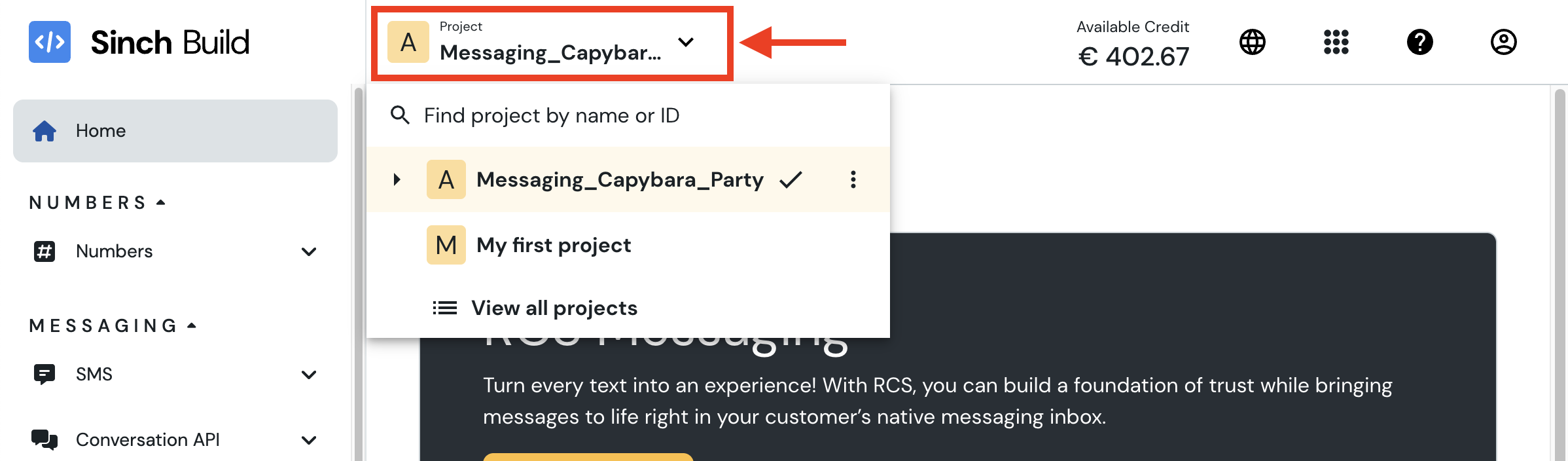
- Verification API credentials: navigate to the Verification / Apps section of the Sinch Build dashboard and create a new app or select an existing one. You will need the following credentials:
- (Required) `APPLICATION_KEY`
- (Required) `APPLICATION_SECRET`
- Voice API credentials: navigate to the Voice / Apps section of the Sinch Build dashboard and create a new app or select an existing one. You will need the following credentials:
- (Required) `APPLICATION_KEY`
- (Required) `APPLICATION_SECRET`
- You can also set the `CALLING_LINE_IDENTIFICATION` environment variable to the phone number that will be displayed to the user when they receive a call.
- Mailgun API credentials: navigate to the Mailgun / Domains section of the Mailgun dashboard and create a new domain or select an existing one. You will need the following credentials:
- (Required) `MAILGUN_API_KEY`
- `MAILGUN_DOMAIN`
- `MAILGUN_SENDER_ADDRESS`
MCP Server Configuration
The Sinch MCP server is available as an NPM package to the executed. Here is how to set it up in the Claude Desktop configuration file (`claude_desktop_config.json`). Remember to fill in the environment variables with your own credentials:
{
  "mcpServers": {
    "sinch": {
      "command": "npx",
      "args": ["-y", "@sinch/mcp"],
      "env": {
        "PROJECT_ID": "",
        "KEY_ID": "",
        "KEY_SECRET": "",
        "CONVERSATION_APP_ID": "",
        "CONVERSATION_REGION": "",
        "DEFAULT_SMS_ORIGINATOR": "",
        "GEOCODING_API_KEY": "",
        "APPLICATION_KEY": "",
        "APPLICATION_SECRET": "",
        "CALLING_LINE_IDENTIFICATION": "",
        "MAILGUN_API_KEY": "",
        "MAILGUN_DOMAIN": "",
        "MAILGUN_SENDER_ADDRESS": ""
      }
    }
  }
}
Running the MCP Server locally
Option 1: Start the MCP server with stdio using Claude Desktop
To run the MCP server locally with Claude Desktop, you will need to clone the repository and build the MCP server. This option is useful for local development and testing.
Step 1: Clone the repository
git clone https://github.com/sinch/sinch-mcp-server.gitStep 2: Build the MCP server
cd sinch-mcp-server
npm install
npm run build
Step 3: Setup Claude Desktop configuration
Here is an example of how to configure the MCP server in the Claude Desktop configuration file (`claude_desktop_config.json`):
{
  "mcpServers": {
    "sinch": {
      "command": "node",
      "args": ["/your/path/to/sinch-mcp-server/dist/index.js"],
      "env": {
        "PROJECT_ID": "",
        "KEY_ID": "",
        "KEY_SECRET": "",
        "CONVERSATION_APP_ID": "",
        "CONVERSATION_REGION": "",
        "DEFAULT_SMS_ORIGINATOR": "",
        "GEOCODING_API_KEY": "",
        "APPLICATION_KEY": "",
        "APPLICATION_SECRET": "",
        "CALLING_LINE_IDENTIFICATION": "",
        "MAILGUN_API_KEY": "",
        "MAILGUN_DOMAIN": "",
        "MAILGUN_SENDER_ADDRESS": ""
      }
    }
  }
}
Step 4: (Optional) Filter the tools available in the MCP server
Too many tools mean bigger context, mean higher tokens usage and more confusion for the LLM to select the right tool to use.
You can filter the tools that are available in the MCP server by using the `tags` options. For example, if you want to only use the conversation tools, you can add the following options to the `args` array:
"args": [
        "/your/path/to/sinch-mcp-server/dist/index.js",
        "--tags",
        "conversation"
      ],
You can combine multiple tags by separating them with commas. For example, if you want to use both conversation and verification tools, you can use the following command:
"args": [
        "/your/path/to/sinch-mcp-server/dist/index.js",
        "--tags",
        "conversation,verification"
      ],
Available tags: `conversation`, `rcs`, `whatsapp`, `email`, `verification`, `voice`, `numbers`, `notification`, `configuration`, `all`.
If you want to use all the tools, you can omit the `--tags` option, or use the tag `all`:
"args": [
        "/your/path/to/sinch-mcp-server/dist/index.js",
        "--tags",
        "all"
      ],
Option 2: Start the MCP server remotely and connect to it using SSE
With this option, you can run the MCP server on a remote machine and connect to it using Server-Sent Events (SSE). This is useful if you want to run the MCP server on a cloud server or a dedicated machine.
By default, Claude Desktop will connect to the MCP server using STDIO; we will use the supergateway library to connect to the MCP server using SSE.
Step 1: Build the MCP server
cd sinch-mcp-server
npm install
npm run build
Step 2: Set up the MCP server configuration
Copy the file `.template.env` and rename it `.env`. Then replace the placeholders with your own credentials and delete any key you don't need. Environment variables are parsed and typed at server startup via T3 Env; missing credentials only cause errors when you invoke a tool that requires them. The `.env` file should look like this ():
# Conversation / Numbers tools related environment variables
PROJECT_ID=
KEY_ID=
KEY_SECRET=
## Optional but recommended: the App ID holding your channels integration configuration. If not set it must be present in the prompt
CONVERSATION_APP_ID=
## Optional, defaults to "us". Other possible values are "eu" and "br"
CONVERSATION_REGION=
## Needed only if you want to send SMS messages: it is the number that will be used as the sender for SMS messages
DEFAULT_SMS_ORIGINATOR=
## Needed only if you want to send location messages: it converts an address to a latitude/longitude pair
GEOCODING_API_KEY=

# Verification / Voice tools related environment variables
APPLICATION_KEY=
APPLICATION_SECRET=
## Needed only if you want to make calls: it is the number that will be displayed to the user when they receive a call
CALLING_LINE_IDENTIFICATION=

# Mailgun tools related environment variables
MAILGUN_DOMAIN=
MAILGUN_API_KEY=
MAILGUN_SENDER_ADDRESS=
Step 3: Start the MCP server
npm run start:stdioBy default, this command will start the MCP with all the tools available. If you want to filter the tools that are available in the MCP server, you can use the `--tags` option. For example, if you want to only use the conversation tools, you can modify the command as follows:
# Original command
"start:sse": "tsc --project tsconfig.build.json && (npx -y supergateway --stdio \"node dist/index.js\" --port 8000 --baseUrl http://localhost:8000 --ssePath /sse --messagePath /message)"

# Modified command to only use conversation tools
"start:sse": "tsc --project tsconfig.build.json && (npx -y supergateway --stdio \"node dist/index.js --tag conversation\" --port 8000 --baseUrl http://localhost:8000 --ssePath /sse --messagePath /message)"
You can combine multiple tags by separating them with commas. For example, if you want to use both conversation and verification tools, you can use the following command:
"start": "tsc --project tsconfig.build.json && (npx -y supergateway --stdio \"node dist/index.js --tag conversation,verification\" --port 8000 --baseUrl http://localhost:8000 --ssePath /sse --messagePath /message)"Step 4: Configure the MCP server in Claude Desktop
You can then configure the MCP server in the Claude configuration file as follows:
{
  "mcpServers": {
    "sinch": {
      "command": "npx",
      "args": ["-y", "supergateway", "--sse", "http://localhost:8000/sse"]
    }
  }
}
(Replace the `http://localhost:8000/sse` with the URL of your MCP server if it is not running locally)
Option 3: Native Streamable HTTP server (recommended for remote)
This option runs a native Streamable HTTP MCP server on `/mcp`. Choose single-tenant or multi-tenant deployment — they are mutually exclusive.
Step 1: Build the MCP server
cd sinch-mcp-server
npm install
npm run build
Step 2: Choose a deployment mode
Single-tenant (one Sinch account per server)
Use when every client of this MCP instance shares the same Sinch project. Configure credentials on the server; clients only authenticate to the MCP gateway.
MCP_API_KEY=your-secret-mcp-api-key
PORT=8000
PROJECT_ID=
KEY_ID=
KEY_SECRET=
Remote clients send one header on every request:
| Header | Value |
|---|---|
| `Authorization` | `Bearer ` |
`MCP_API_KEY` (or comma-separated `MCP_API_KEYS` for key rotation) authorizes access to the MCP server. `PROJECT_ID`, `KEY_ID`, and `KEY_SECRET` are read from the server environment only — `X-Sinch-Credentials` is ignored in this mode (no client override of server credentials).
Multi-tenant (each client brings a Sinch account)
Use when different clients must use different Sinch projects. Do not set `MCP_API_KEY` on the server. Each client sends its own credentials on every request.
Remote clients send one header on every request:
| Header | Value |
|---|---|
| `X-Sinch-Credentials` | Base64-encoded `projectId:keyId:keySecret` |
The server does not read `PROJECT_ID`, `KEY_ID`, or `KEY_SECRET` from its environment for OAuth-backed tools in this mode. OAuth clients are cached in memory with LRU eviction (default 256 entries, configurable via `OAUTH_TOKEN_CACHE_MAX_ENTRIES`).
In multi-tenant mode, `CONVERSATION_REGION` is required: the server refuses to start without it, and it is never defaulted to `us`. Each deployment is pinned to a single region, and the region cannot be overridden per request or from the prompt.
`X-Sinch-Credentials` format (multi-tenant only)
1. Build a UTF-8 string: `projectId:keyId:keySecret` (see API credentials).
2. Encode with standard Base64 (no line breaks).
3. Send on each HTTP request (including after MCP session initialization).
The access key secret may contain `:` characters; only the first two colons separate the three fields.
Example (multi-tenant):
export SINCH_CREDS=$(printf '%s' 'my-project-id:my-key-id:my-key-secret' | base64)

curl -X POST "http://localhost:8000/mcp" \
  -H "X-Sinch-Credentials: ${SINCH_CREDS}" \
  -H "Content-Type: application/json" \
  -H "Accept: application/json, text/event-stream" \
  -d '{"jsonrpc":"2.0","id":1,"method":"initialize","params":{"protocolVersion":"2024-11-05","capabilities":{},"clientInfo":{"name":"example","version":"1.0.0"}}}'
Scope: `X-Sinch-Credentials` applies to Conversation, Numbers, and Number Lookup tools. Voice, Verification, and Mailgun still use server environment variables for now. Local stdio (Option 1) always uses server environment variables.
`x-agent-id` header (multi-tenant only)
Agent integrations (e.g. an agent installed in a Gemini Enterprise app) may send an `x-agent-id` header carrying the unique installation identifier (the Marketplace OrderId). Its purpose is to distinguish which installation is calling the MCP server, so it is meant for multi-tenant deployments only: it will be used to resolve the caller's Sinch credentials in an upcoming release. In single-tenant mode credentials always come from the server environment, so the header serves no purpose there. This custom header is a temporary mechanism until a token-exchange capability is available over M2M authentication.
| Header | Value |
|---|---|
| `x-agent-id` | Agent installation identifier (e.g. GE `OrderId`) |
`Authorization` user JWT (optional)
After the end-user completes the OAuth login and consent flow, agent integrations may send the resulting Auth0 user JWT on each request:
| Header | Value |
|---|---|
| `Authorization` | `Bearer ` |
The server base64-decodes the JWT payload and captures the Sinch claims (`https://sinch.com/project_id`, `https://sinch.com/account_id`, `https://sinch.com/global_user_id`) and the standard `scope` claim in the request context, logging them for audit purposes only. The token signature is not verified and the claims are never used to resolve API credentials (the `x-agent-id` header serves that purpose). A missing or malformed token is ignored and the request proceeds normally. In the long term, the user JWT will be exchanged for an M2M JWT, replacing the custom headers.
Note: in single-tenant mode the `Authorization` header carries the MCP API key instead; an opaque key is not a JWT, so no claims are captured.
MCP_API_KEYS key rotation
Use `MCP_API_KEYS` (comma-separated) in single-tenant mode to accept an old and new gateway key during rotation, then remove the retired key.
Step 3: Start the HTTP server
npm run start:http:serverThe server listens on `http://localhost:8000/mcp` by default (override with `PORT`).
Session storage (Redis)
Session identity is stored in Redis, not in process memory, so any pod behind a load balancer can validate any session — no sticky sessions required. Each request builds its own short-lived `McpServer` and `StreamableHTTPServerTransport`, closed once the response finishes; nothing is held in memory between requests. Redis is required — the server exits immediately on startup unless both `REDIS_HOST` and `REDIS_PORT` are set (`REDIS_PASSWORD` is optional; TLS turns on automatically once it's set, e.g. for AWS ElastiCache). If Redis is unreachable after a short retry, the server returns 503 Service Unavailable with JSON-RPC error code `-32003`, distinct from `-32001 Session not found`.
Because there's no persistent per-session transport, the server doesn't support the standalone GET/SSE stream — `GET /mcp` returns 405. Server-initiated notifications sent during a POST (e.g. tool progress) work as usual; a notification pushed independently of any request would have nowhere to go once transports are per-request.
Step 4: Example MCP client configuration
Single-tenant:
{
  "mcpServers": {
    "sinch-remote": {
      "url": "https://your-host.example.com/mcp",
      "headers": {
        "Authorization": "Bearer "
      }
    }
  }
}
Multi-tenant:
{
  "mcpServers": {
    "sinch-remote": {
      "url": "https://your-host.example.com/mcp",
      "headers": {
        "X-Sinch-Credentials": ""
      }
    }
  }
}
After the `initialize` response, include the `mcp-session-id` header returned by the server on subsequent requests.
Contributing
See CONTRIBUTING.md for contributor guidelines, including how to add new tools and pin GitHub Actions.
Frequently asked questions
What is sinch-mcp-server?
sinch-mcp-server is Exposing Sinch's APIs as MCP Tools
How do I install sinch-mcp-server?
Open the GitHub repository and follow its README. Most MCP servers are added to your client's MCP config, then called by your agent.
Is sinch-mcp-server open source?
Yes — it is hosted on GitHub at https://github.com/sinch/sinch-mcp-server and has 1 stars.
Related MCP tools
 servers
Model Context Protocol Servers
 UI-TARS-desktop
The Open-Source Multimodal AI Agent Stack: Connecting Cutting-Edge AI Models and Agent Infra
 n8n-mcp
A MCP for Claude Desktop / Claude Code / Windsurf / Cursor to build n8n workflows for you
 Figma-Context-MCP
MCP server to provide Figma layout information to AI coding agents like Cursor
 inbox-zero
The world's best AI personal assistant for email. Open source app to help you reach inbox zero fast.
 instant
Instant is the best backend for AI-coded apps. You get auth, permissions, storage, presence, and streams — everything you need to ship apps your users will love.
Run your own MCP server? See who uses it and what to fix.
Measure it with TrackMCP