
mcp-server-mysql
MySQL Server
Documentation
MCP Server for MySQL based on NodeJS
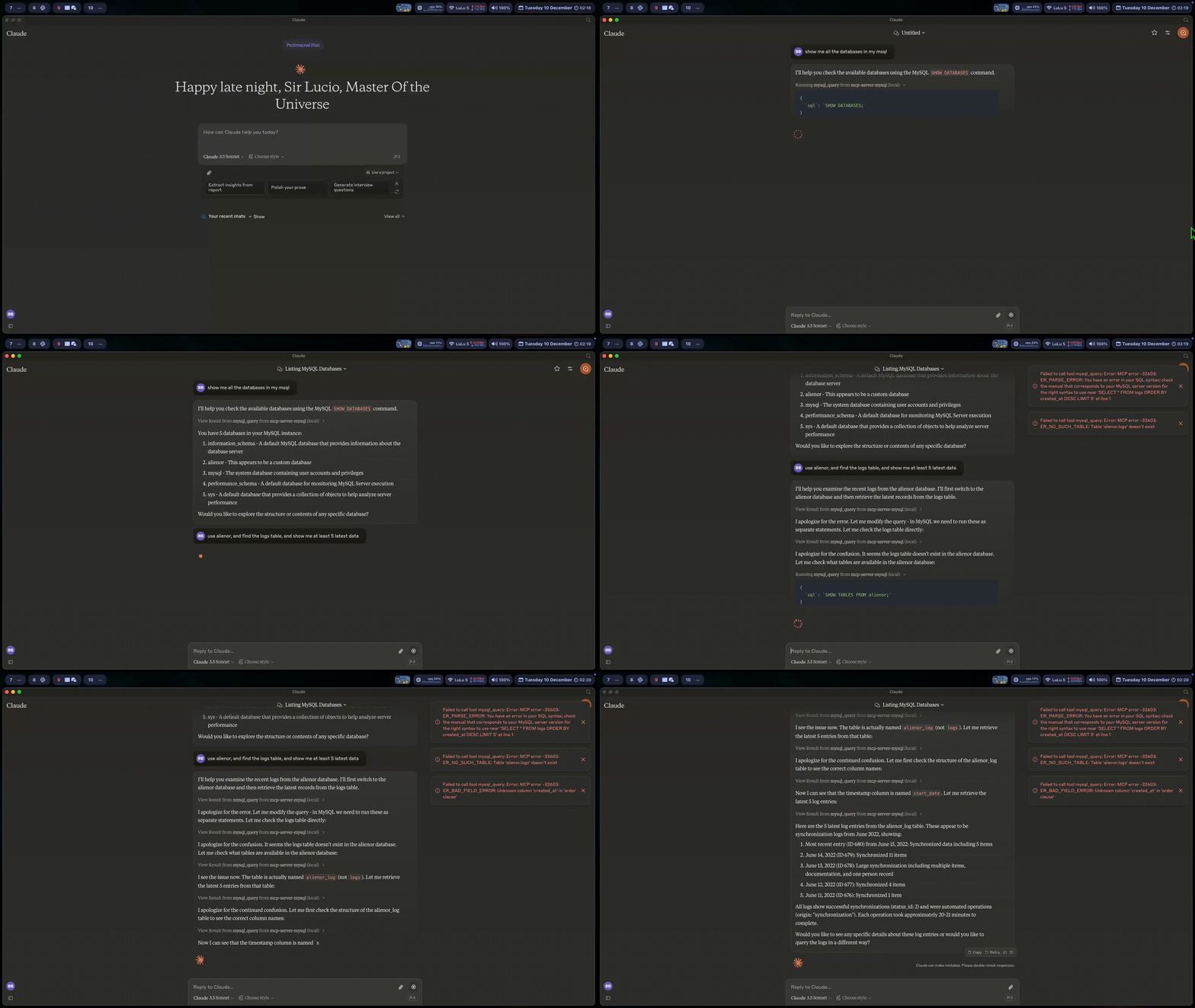
A Model Context Protocol server that provides read-only access to MySQL databases. This server enables LLMs to inspect database schemas and execute read-only queries.
Installation
Using Smithery
The easiest way to install and configure this MCP server is through Smithery:
# Install the MCP server
npx -y @smithery/cli@latest install @benborla29/mcp-server-mysql --client claude
During configuration, you'll be prompted to enter your MySQL connection details. Smithery will automatically:
- Set up the correct environment variables
- Configure your LLM application to use the MCP server
- Test the connection to your MySQL database
- Provide helpful troubleshooting if needed
Using MCP Get
You can also install this package using MCP Get:
npx @michaellatman/mcp-get@latest install @benborla29/mcp-server-mysqlMCP Get provides a centralized registry of MCP servers and simplifies the installation process.
Using NPM/PNPM
For manual installation:
# Using npm
npm install -g @benborla29/mcp-server-mysql

# Using pnpm
pnpm add -g @benborla29/mcp-server-mysql
After manual installation, you'll need to configure your LLM application to use the MCP server (see Configuration section below).
Components
Tools
- mysql_query
- Execute read-only SQL queries against the connected database
- Input: `sql` (string): The SQL query to execute
- All queries are executed within a READ ONLY transaction
- Supports prepared statements for secure parameter handling
- Configurable query timeouts and result pagination
- Built-in query execution statistics
Resources
The server provides comprehensive database information:
- Table Schemas
- JSON schema information for each table
- Column names and data types
- Index information and constraints
- Foreign key relationships
- Table statistics and metrics
- Automatically discovered from database metadata
Security Features
- SQL injection prevention through prepared statements
- Query whitelisting/blacklisting capabilities
- Rate limiting for query execution
- Query complexity analysis
- Configurable connection encryption
- Read-only transaction enforcement
Performance Optimizations
- Optimized connection pooling
- Query result caching
- Large result set streaming
- Query execution plan analysis
- Configurable query timeouts
Monitoring and Debugging
- Comprehensive query logging
- Performance metrics collection
- Error tracking and reporting
- Health check endpoints
- Query execution statistics
Configuration
Automatic Configuration with Smithery
If you installed using Smithery, your configuration is already set up. You can view or modify it with:
smithery configure @benborla29/mcp-server-mysqlManual Configuration for Claude Desktop App
To manually configure the MCP server for Claude Desktop App, add the following to your `claude_desktop_config.json` file (typically located in your user directory):
{
  "mcpServers": {
    "mcp_server_mysql": {
      "command": "npx",
      "args": [
        "-y",
        "@benborla29/mcp-server-mysql"
      ],
      "env": {
        "MYSQL_HOST": "127.0.0.1",
        "MYSQL_PORT": "3306",
        "MYSQL_USER": "root",
        "MYSQL_PASS": "",
        "MYSQL_DB": "db_name"
      }
    }
  }
}
Replace `db_name` with your database name or leave it blank to access all databases.
Advanced Configuration Options
For more control over the MCP server's behavior, you can use these advanced configuration options:
{
  "mcpServers": {
    "mcp_server_mysql": {
      "command": "/path/to/npx/binary/npx",
      "args": [
        "-y",
        "@benborla29/mcp-server-mysql"
      ],
      "env": {
        // Basic connection settings
        "MYSQL_HOST": "127.0.0.1",
        "MYSQL_PORT": "3306",
        "MYSQL_USER": "root",
        "MYSQL_PASS": "",
        "MYSQL_DB": "db_name",
        "PATH": "/path/to/node/bin:/usr/bin:/bin",

        // Performance settings
        "MYSQL_POOL_SIZE": "10",
        "MYSQL_QUERY_TIMEOUT": "30000",
        "MYSQL_CACHE_TTL": "60000",

        // Security settings
        "MYSQL_RATE_LIMIT": "100",
        "MYSQL_MAX_QUERY_COMPLEXITY": "1000",
        "MYSQL_SSL": "true",

        // Monitoring settings
        "MYSQL_ENABLE_LOGGING": "true",
        "MYSQL_LOG_LEVEL": "info",
        "MYSQL_METRICS_ENABLED": "true"
      }
    }
  }
}
Environment Variables
Basic Connection
- `MYSQL_HOST`: MySQL server host (default: "127.0.0.1")
- `MYSQL_PORT`: MySQL server port (default: "3306")
- `MYSQL_USER`: MySQL username (default: "root")
- `MYSQL_PASS`: MySQL password
- `MYSQL_DB`: Target database name
Performance Configuration
- `MYSQL_POOL_SIZE`: Connection pool size (default: "10")
- `MYSQL_QUERY_TIMEOUT`: Query timeout in milliseconds (default: "30000")
- `MYSQL_CACHE_TTL`: Cache time-to-live in milliseconds (default: "60000")
Security Configuration
- `MYSQL_RATE_LIMIT`: Maximum queries per minute (default: "100")
- `MYSQL_MAX_QUERY_COMPLEXITY`: Maximum query complexity score (default: "1000")
- `MYSQL_SSL`: Enable SSL/TLS encryption (default: "false")
Monitoring Configuration
- `MYSQL_ENABLE_LOGGING`: Enable query logging (default: "false")
- `MYSQL_LOG_LEVEL`: Logging level (default: "info")
- `MYSQL_METRICS_ENABLED`: Enable performance metrics (default: "false")
Testing
Database Setup
Before running tests, you need to set up the test database and seed it with test data:
1. Create Test Database and User
-- Connect as root and create test database
   CREATE DATABASE IF NOT EXISTS mcp_test;

   -- Create test user with appropriate permissions
   CREATE USER IF NOT EXISTS 'mcp_test'@'localhost' IDENTIFIED BY 'mcp_test_password';
   GRANT ALL PRIVILEGES ON mcp_test.* TO 'mcp_test'@'localhost';
   FLUSH PRIVILEGES;
2. Run Database Setup Script
# Run the database setup script
   pnpm run setup:test:db
This will create the necessary tables and seed data. The script is located in `scripts/setup-test-db.ts`
3. Configure Test Environment
Create a `.env.test` file in the project root:
MYSQL_HOST=127.0.0.1
   MYSQL_PORT=3306
   MYSQL_USER=mcp_test
   MYSQL_PASS=mcp_test_password
   MYSQL_DB=mcp_test
4. Update package.json Scripts
Add these scripts to your package.json:
{
     "scripts": {
       "setup:test:db": "ts-node scripts/setup-test-db.ts",
       "pretest": "pnpm run setup:test:db",
       "test": "vitest run",
       "test:watch": "vitest",
       "test:coverage": "vitest run --coverage"
     }
   }
Running Tests
The project includes a comprehensive test suite to ensure functionality and reliability:
# First-time setup
pnpm run setup:test:db

# Run all tests
pnpm test
Troubleshooting
Using Smithery for Troubleshooting
If you installed with Smithery, you can use its built-in diagnostics:
# Check the status of your MCP server
smithery status @benborla29/mcp-server-mysql

# Run diagnostics
smithery diagnose @benborla29/mcp-server-mysql

# View logs
smithery logs @benborla29/mcp-server-mysql
Using MCP Get for Troubleshooting
If you installed with MCP Get:
# Check the status
mcp-get status @benborla29/mcp-server-mysql

# View logs
mcp-get logs @benborla29/mcp-server-mysql
Common Issues
1. Connection Issues
2. Performance Issues
3. Security Restrictions
4. Path Resolution
If you encounter an error "Could not connect to MCP server mcp-server-mysql", explicitly set the path of all required binaries:
{
  "env": {
    "PATH": "/path/to/node/bin:/usr/bin:/bin"
  }
}
5. Authentication Issues
CREATE USER 'user'@'localhost' IDENTIFIED WITH mysql_native_password BY 'password';

## Contributing

Contributions are welcome! Please feel free to submit a Pull Request to
https://github.com/benborla/mcp-server-mysql

### Development Setup

1. Clone the repository
2. Install dependencies: `pnpm install`
3. Build the project: `pnpm run build`
4. Run tests: `pnpm test`

### Project Roadmap

We're actively working on enhancing this MCP server. Check our [CHANGELOG.md](./CHANGELOG.md) for details on planned features, including:

- Enhanced query capabilities with prepared statements
- Advanced security features
- Performance optimizations
- Comprehensive monitoring
- Expanded schema information

If you'd like to contribute to any of these areas, please check the issues on GitHub or open a new one to discuss your ideas.

### Submitting Changes

1. Fork the repository
2. Create a feature branch: `git checkout -b feature/your-feature-name`
3. Commit your changes: `git commit -am 'Add some feature'`
4. Push to the branch: `git push origin feature/your-feature-name`
5. Submit a pull request

## License

This MCP server is licensed under the MIT License. See the LICENSE file for details.Frequently asked questions
What is mcp-server-mysql?
mcp-server-mysql is MySQL Server
How do I install mcp-server-mysql?
Open the GitHub repository and follow its README. Most MCP servers are added to your client's MCP config, then called by your agent.
Is mcp-server-mysql open source?
Yes — it is hosted on GitHub at https://github.com/zhaoxin34/mcp-server-mysql and has 1 stars.
Related MCP tools
 servers
Model Context Protocol Servers
 UI-TARS-desktop
The Open-Source Multimodal AI Agent Stack: Connecting Cutting-Edge AI Models and Agent Infra
 n8n-mcp
A MCP for Claude Desktop / Claude Code / Windsurf / Cursor to build n8n workflows for you
 Figma-Context-MCP
MCP server to provide Figma layout information to AI coding agents like Cursor
 inbox-zero
The world's best AI personal assistant for email. Open source app to help you reach inbox zero fast.
 instant
Instant is the best backend for AI-coded apps. You get auth, permissions, storage, presence, and streams — everything you need to ship apps your users will love.
Run your own MCP server? See who uses it and what to fix.
Measure it with TrackMCP